
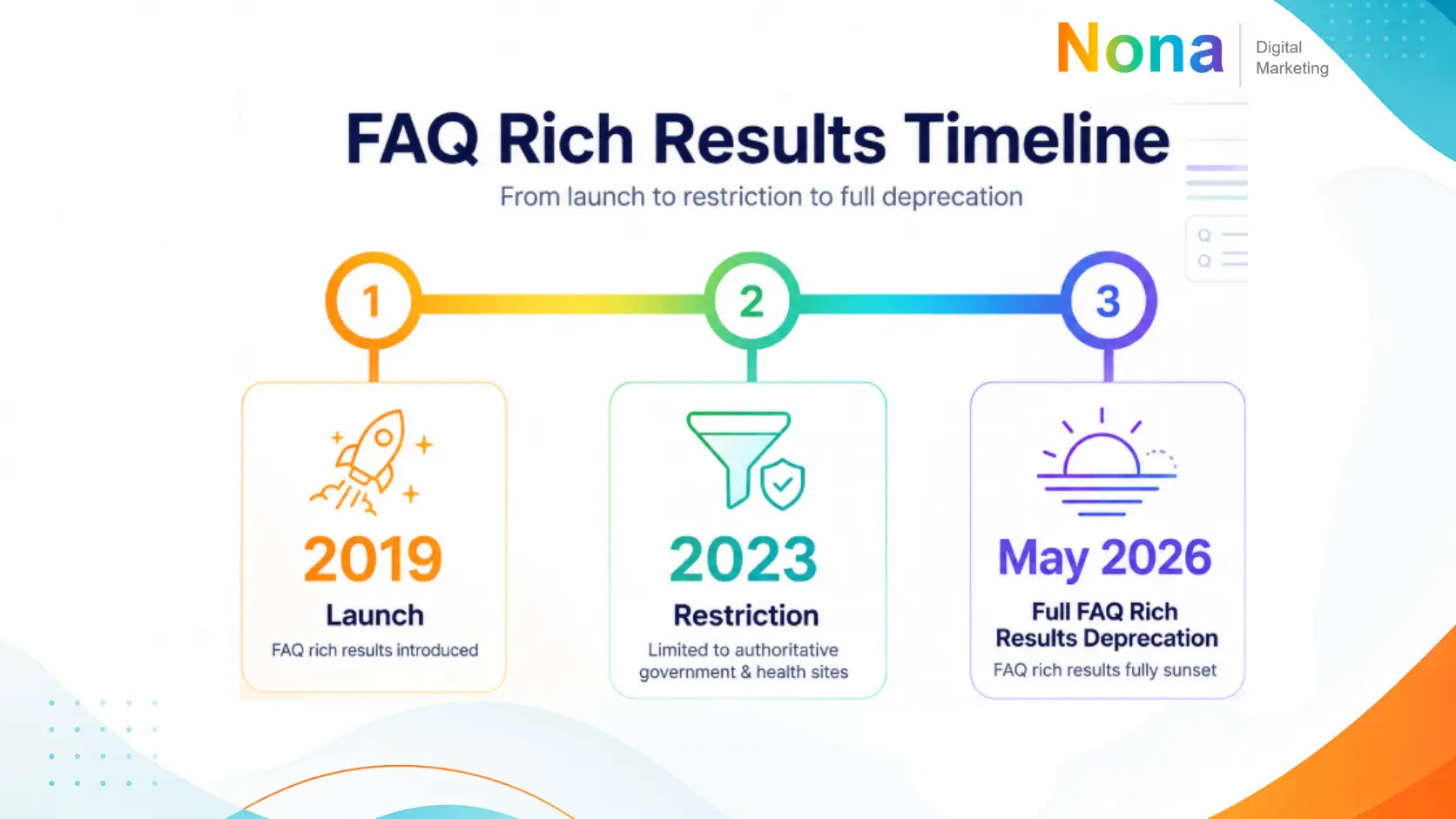
As of May 7, 2026, the expandable FAQ dropdowns that once made search listings pop have officially vanished from Google Search. No warnings, no second chances. The feature is gone, and the ripple effects are already being felt across the SEO world.
Table of Contents
Why Google removed FAQ rich results
The short answer: people abused it.
When FAQ rich results first rolled out, they were a legitimate game-changer. A well-structured FAQ section could transform a standard blue link into an expanded, accordion-style listing that answered multiple questions directly in the search results, no click required. Visibility went up. Click-through rates followed.
Then came the flood. Let’s take a quick look at the sample below.
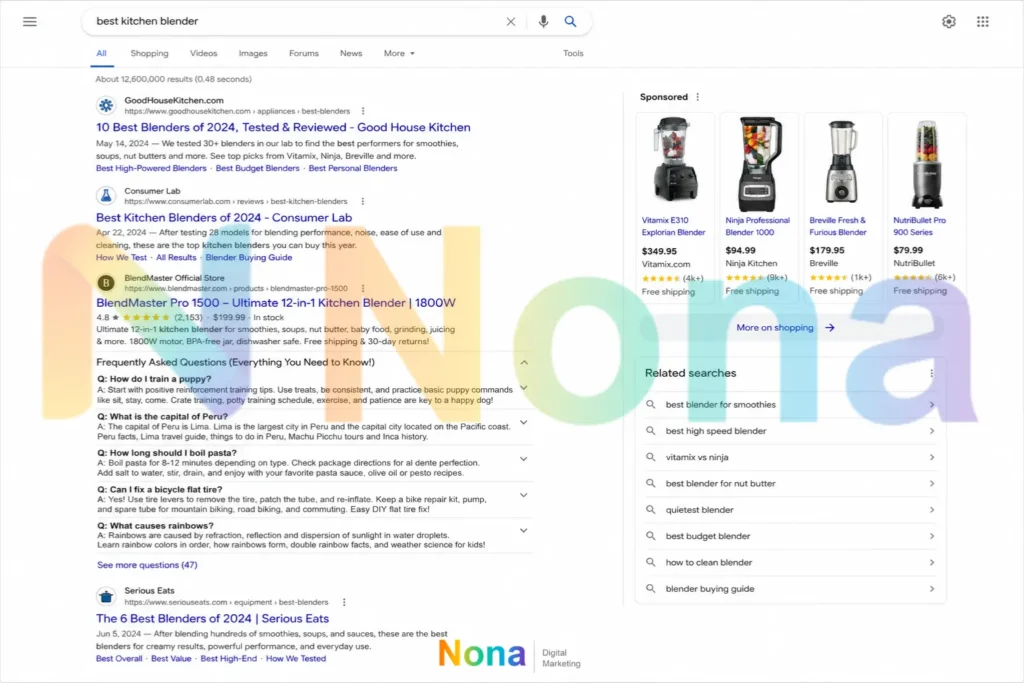
A product result for “BlendMaster Pro 1500, Ultimate 12-in-1 Kitchen Blender” is displaying an expanded FAQ rich result, but the FAQ questions are mostly unrelated to the product or the search query “best kitchen blender.”
Examples of the abusive Q&As:
“How do I train a puppy?”
“What is the capital of Peru?”
“How long should I boil pasta?”
“Can I fix a bicycle flat tire?”
“What causes rainbows?”
These FAQs are irrelevant to a kitchen blender product page. They appear to be stuffed under the result to take up more SERP space, attract clicks from unrelated searches, and manipulate visibility.
A legitimate FAQ section for that product would include questions like:
“Is the blender dishwasher safe?”
“Can it crush ice?”
“What is the jar capacity?”
“Does it come with a warranty?”
“Can it make nut butter?”
So the abuse is: using structured FAQ markup to inject unrelated, keyword-stuffed Q&As into search results for a product page.
Within months, sites of every shape and size started stuffing artificial FAQ sections into pages where they had no business being. A plumbing company’s homepage suddenly had twelve “frequently asked questions.” A product page for running shoes somehow answered questions about marathon training. Low-effort, copy-paste Q&A content multiplied across the web, not because users needed it, but because it grabbed more pixels on the SERP.
Google eventually drew the line in August 2023, restricting FAQ rich results to authoritative government and health websites only. That move cut off most of the abuse, but the feature had already lost credibility. May 2026 simply marks the final chapter: a complete, permanent shutdown for every category of website.
The message from Google is clear, if a feature gets gamed at scale, it gets removed at scale.
What’s the real impact for content creators?
For creators who played by the rules and used FAQ schema genuinely, this stings. A well-executed FAQ listing could dominate a search result, pushing competitors below the fold and answering objections before a user ever landed on the page. That visibility boost is now gone.
Here’s what to expect in the weeks ahead:
- Lower CTR on FAQ-heavy pages. If your listing previously showed expandable answers, your result now looks like everyone else’s. Same ranking, smaller footprint.
- Drop in impressions. Pages that relied on FAQ dropdowns to attract curiosity clicks may see traffic dip even if their position holds steady.
- Broken dashboards. If you or your agency built Search Console reports pulling FAQ rich result data, those integrations will break in August 2026 when the API support is retired.
The creators most at risk are those who optimized for the feature rather than for the user, pages built around schema tricks rather than genuinely useful content. For them, this isn’t just a UI change; it’s an exposure of a strategy that was always on borrowed time.
What Happens to Your Structured Data?
Here’s the nuance most coverage is missing: FAQ schema and FAQ rich results are not the same thing.
Google has ended the display feature. It has not dismissed the structured data itself.
In fact, Google’s own deprecation notice quietly confirmed that it will continue to use FAQPage structured data to better understand pages, just without surfacing the visual dropdown. That’s a meaningful distinction. Schema markup has always been a way of speaking to machines in their language, telling search systems what a piece of content is, who it’s for, and why it’s relevant. That function doesn’t disappear because a SERP decoration was retired.
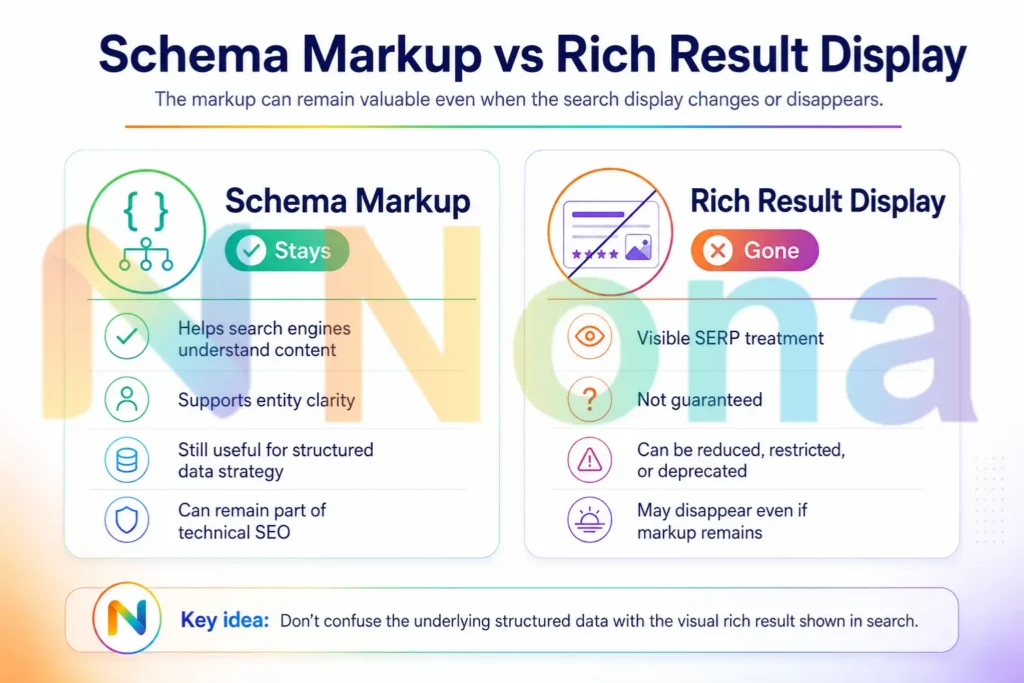
The practical takeaway: don’t rush to strip FAQ schema from your site. If your Q&A content is real, visible on the page, and genuinely answers user questions, the markup still earns its place. Other search engines may also continue to use it. And as AI-powered search grows, clearly structured content that AI systems can parse and cite becomes more valuable, not less.
Where to focus your SEO strategy now
The retirement of FAQ rich results is part of a longer arc. Google has been quietly simplifying the traditional SERP for years: HowTo rich results were deprecated in 2023, review schema has been restricted, and sitelink appearances have been reduced on mobile. The direction of travel is unmistakable, Google is building for AI-first search, not pixel-first search. Because SEO has never been just about keywords, and Google’s been signaling that for years
That means the content strategies that win going forward look different:
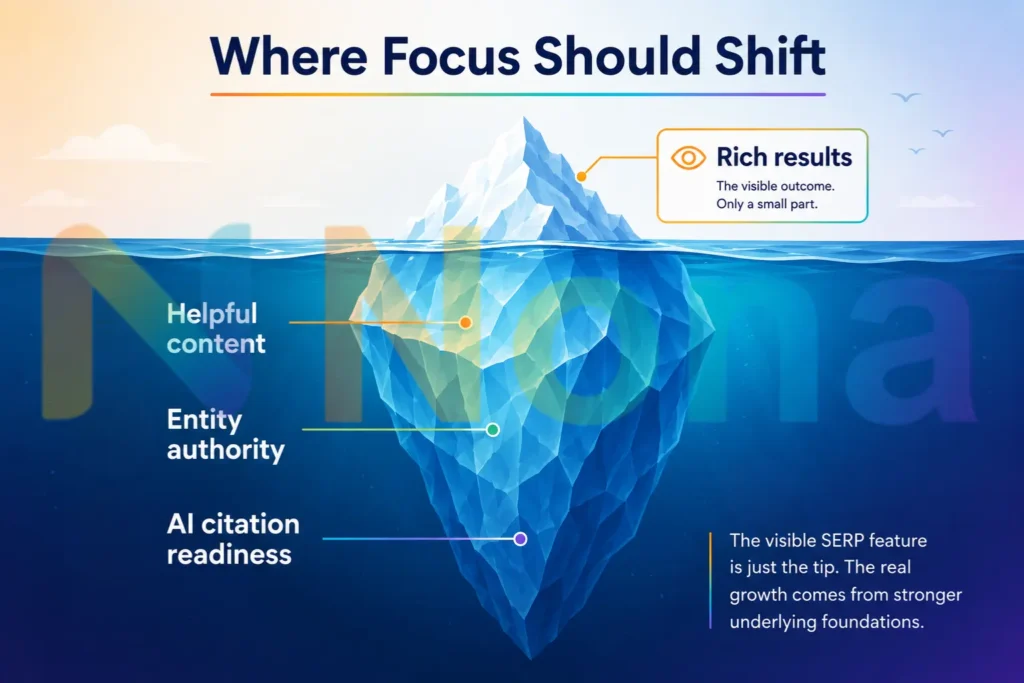
Helpful content over schema tricks. Google’s Helpful Content system rewards pages written for people, not for search features. Clear, honest, substantive answers that actually resolve a user’s question, that’s the new currency. If you’re using AI to produce that content, doing it the right way matters more than ever.
Entity clarity and topical authority. Structured data that helps Google understand what your site is about and who you serve matters more than structured data that inflates your listing size. Article schema, LocalBusiness schema, Product schema, and HowTo schema (where genuinely applicable) all remain valid.
AI citation readiness. As AI Overviews and other generative search features expand, the pages being cited are the ones that are authoritative, well-structured, and easy for machines to interpret.
If your FAQ content is strong, keep it, and mark it up properly. Being the source an AI cites is worth more than an expandable dropdown ever was. Learn how H2 and H3 headings directly influence whether your content gets cited by AI systems.
How to prepare for the FAQ rich results change
The window to act is short. Here’s a practical checklist:
- Export your FAQ rich result data from Search Console now, before the reporting disappears in June 2026.
- Audit pages that previously showed FAQ dropdowns and compare CTR before and after May 7. Know what you lost.
- Don’t do a mass schema purge. Review FAQ markup page by page. Keep it where the content is real and visible. Remove it only where the schema was decorative or misleading.
- Update API integrations that pull FAQ data from Search Console before August 2026, or they’ll break silently.
- Reinvest in content depth. Pages that earned FAQ visibility because they genuinely answered questions are still strong pages. Strengthen them further: better introductions, clearer structure, more specific answers.
- Diversify your schema strategy. HowTo, Article, Product, and Event schema still trigger rich results. Use them where they’re accurate and useful.
The bottom line
Google didn’t kill FAQ rich results because FAQ content is bad. It killed them because the feature was too easy to exploit and too hard to police. That’s a pattern worth remembering every time a new structured data opportunity appears.
The creators who will come out ahead aren’t the ones who react fastest to the loss. They’re the ones who already understood that no SERP feature lasts forever, and built their content to be worth reading long after the decorations disappear. That’s a perfect evergreen content moment, link naturally on “worth reading long after” or add: “That’s the definition of evergreen content, and it’s your strongest SEO asset right now.”
Write for people first. Structure for machines second. And never build your traffic strategy on a feature Google can switch off overnight.
Navigating changes like this is exactly what we do at Nona Marketing Digital. From SEO strategy and content creation to paid ads and full-service digital marketing, we help brands stay ahead of every algorithm shift, not just react to them. If Google’s latest move has you rethinking your strategy, let’s talk about our SEO services.
Looking to grow your business with SEO?
Get a strategy tailored to your business and start generating consistent traffic..