
Evergreen content is one of the most powerful SEO strategies to generate consistent, long-term traffic. In this guide, you’ll learn what it is, why it matters, and how to create content that ranks for years.
Unlike time-sensitive content, evergreen content continues to attract traffic long after it’s published by targeting topics people are always searching for.
The problem is that a large portion of the internet’s evergreen content has become a minefield of spam, forced SEO, and bloated text designed solely to hit word count targets. AI has arrived, learned from all of this, and begun delivering the answer, without the noise.
For example, you no longer need to click through to a website to find a bread recipe; simply click on “AI Mode,” and it instantly provides the ingredients, preparation instructions, and even frosting options:
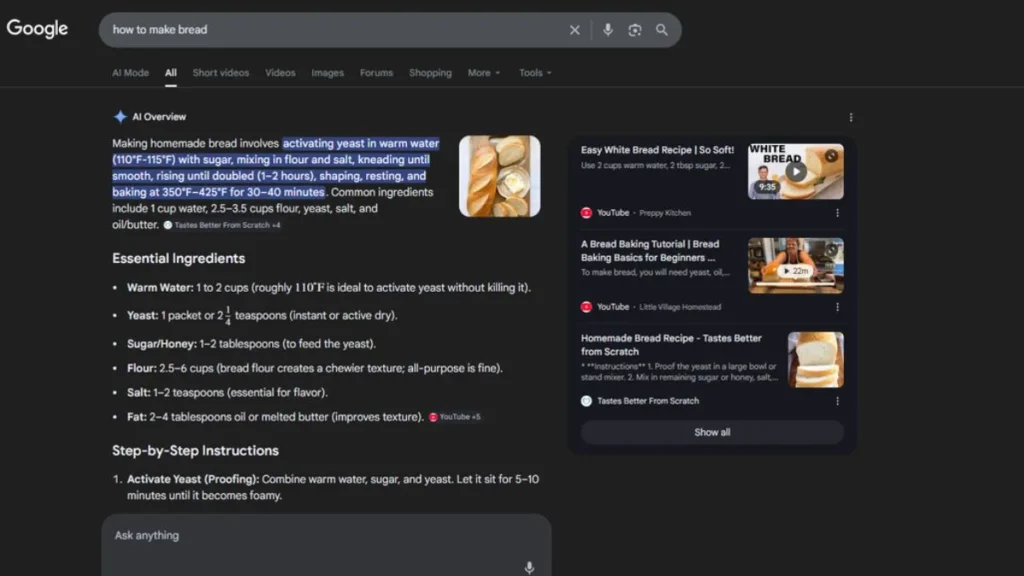
It may seem like the end of the road for evergreen content, but it isn’t. In fact, it remains highly valuable, provided you follow a few key principles:
- Define a clear objective within your overall strategy
- Measure performance beyond conversions
- Create content that delivers genuine informational value
Below, we’ll explore what to avoid when creating evergreen content, and how to do it effectively.
Ready?
What are the benefits of evergreen content?
The main advantages of evergreen content are:
- It generates consistent traffic over long periods of time;
- It is highly shareable across channels such as social media or email marketing, multiple times throughout the year;
- It generates traffic even without frequent updates (though updates are essential);
- It passively attracts leads, provided the content ranks well on Google for its target keyword.
What are the types of evergreen content?
When you write a news piece or follow a trend, you typically get clicks during the first few days, after which the content’s performance drops off. In the case of evergreen content, however, clicks persist for months or even years.
The main types of evergreen content are:
- “How-to” tutorials;
- FAQs or pages that answer specific questions;
- Guides that cover all topics related to a subject;
- Lists;
- Case studies;
- Infographics.
What are examples of evergreen content?
Any topic that remains consistently valuable can be considered evergreen. Here are some ideas for different business segments, falling within the categories presented above:
- How to start investing;
- Investor profiles;
- Retirement planning;
- Effective study habits;
- How to write a resume and cover letter;
- How to prepare for job interviews;
- Easy recipes for beginners;
- Meal prep and packed lunches for busy families;
- How to bake bread at home.
- Nutritional guides for vegan or ketogenic diets;
- Stress management techniques;
So, what counts as “non-evergreen” content?
Beyond evergreen content, within an SEO strategy, content can also be classified as:
- Seasonal: Content that becomes popular during specific times of the year—such as posts about the “history of Christmas lights.”
- Trending: Novelties that are highly popular for a few days or weeks but lose their relevance quickly—such as a post regarding a “new update to Google’s structured data.”
Ideally, an SEO strategy should incorporate all three types of content, as each serves distinct objectives:
Evergreen content drives long-term traffic;
Seasonal content allows you to capitalize on specific time windows;
Trending content can generate short-term results.
Why Evergreen Content Matters for SEO
Evergreen content plays a crucial role in SEO because it continues to generate traffic long after it’s published.
Unlike trending topics that lose relevance quickly, evergreen content targets consistent search demand. This means your content can rank for months or even years, bringing in steady organic traffic without constant updates.
It also helps build topical authority, as search engines recognize your website as a reliable source for long-term, valuable information.
Get a strategy tailored to your business and start generating consistent traffic.
Check our SEO services in OrlandoThe Major Pitfall (and What We Must Avoid) Regarding Evergreen Content
For years, the logic behind evergreen content was simple, almost mechanical: research search volume, write 2,000+ words, publish, and wait for the traffic to roll in.
And it worked, so well, in fact, that everyone started doing the exact same thing.
The result was a web flooded with content that merely paraphrases itself, or worse, outright copies, featuring identical subheadings, FAQs pulled straight from Google’s top results, and little to no original perspective.
The problem is that AI learned from all of this. It consumed this massive volume of repetitive content and began delivering it far more efficiently, directly on the search results page, without anyone ever needing to click anywhere else.
If your content merely repeats what already exists, you are competing against a machine that does it faster, for free, and without complaint. There is simply no way to win that contest.
Consequently, we are now facing several issues:
- Brands that have abandoned evergreen content because they no longer believe it is worth the effort;
- Brands that continue to produce it, but rely on AI to generate content en masse;
- The rampant creation of content “solely for ranking purposes,” without any clear understanding of its role within the customer journey.
This does not mean that evergreen content is dead. It simply means that the old model for producing it certainly is. What AI cannot deliver is precisely what makes content memorable, shareable, and worth following: a unique perspective, original data, and real-world experience. That is exactly where you need to aim.
Before you produce: does your content offer “information gain”?
Information gain refers to creating unique and relevant content on a subject by adding new information to the internet regarding that topic.
It means providing a data point that no one else has collected, an analysis that no one else has performed, or a perspective from someone who truly lives and breathes the subject in practice.
Your writing needs to offer information gain, especially your evergreen content….because:
AI already covers the basics. If your content merely repeats what already exists, a search engine can provide that same answer without the reader ever needing to click through to your site;
Google evaluates the value you add. There is even a patent titled “Contextual Estimation of Link Information Gain,” which indicates how the search engine scores documents based on the extra value they provide;
Without novelty, there is no reason to rank. If your text offers nothing beyond what the top three search results already deliver, the algorithm has no reason to place you above those who are already established;
Without novelty, there is no reason to follow. Readers won’t subscribe to you, share your work, or return to your site if they leave with exactly the same knowledge they had before they arrived;
This is the territory where AI still cannot win. It lacks personal experience, proprietary data, and the perspective of someone working directly in the field. This unique advantage belongs to you, but only if you choose to use it.
Before deciding whether a topic is worth the investment, ask yourself three questions:
- Is this topic central to my product, service, or audience?
- Is there real demand from the public?
- Do I have something new to say about this subject?
If the answer to all three questions is yes, then the investment makes sense. If the answer to even one of them is no, re-evaluate before sinking your time and money into it.
How do you produce evergreen content?
The steps for creating evergreen content follow the general logic of SEO: keywords, content creation, and updates. However, each stage involves specific details designed to ensure that the content remains relevant over the long term and stands out from what already exists.
1. Conduct keyword research
Your goal here is to identify search terms that consistently drive traffic within your specific niche.
To do this, follow the standard keyword research procedure, but pay close attention to terms that demonstrate a stable search volume. Major SEO tools typically provide this information.
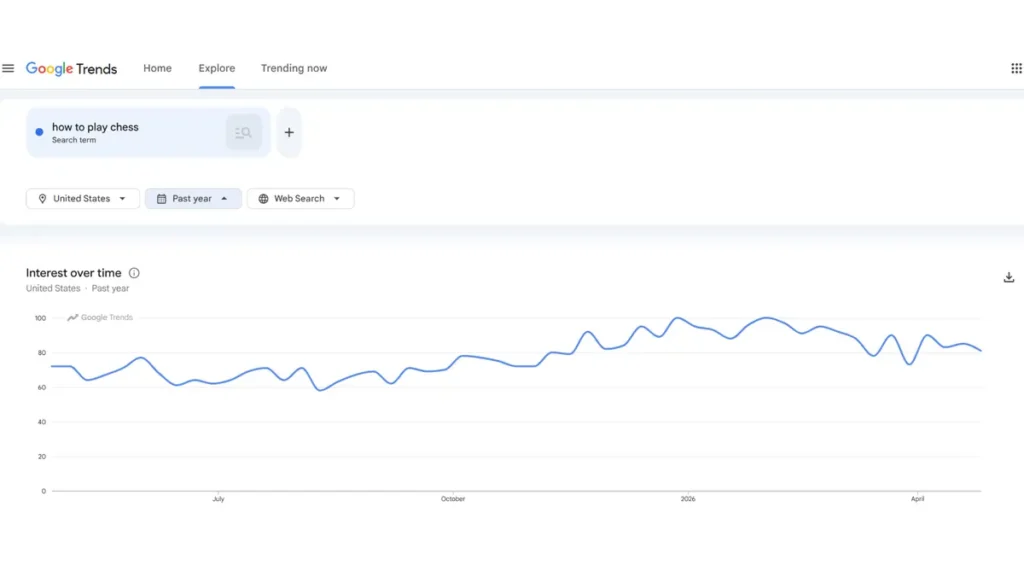
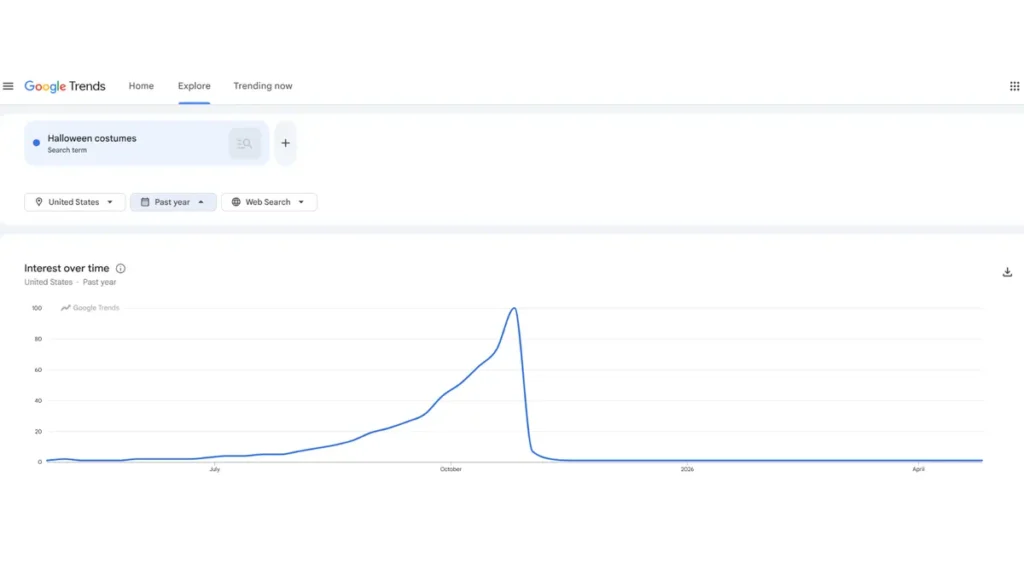
You can also use Google Trends to verify this. Do so by checking the “Interest over time” graph, prioritizing terms that show consistent interest throughout the year.
For example, the graph for the term “how to play chess” shows steady search volume, without any major spikes or dips:
Unlike the graph showing searches for the term “Halloween costumes”, which only sees spikes during the months when the reality show is airing, from January to April:
But take note: search volume is a starting point, not the sole criterion. Before moving forward, verify that you have something new to say on the topic; otherwise, you will be competing against established content without any advantage.
2. Write and Publish the Content
Evergreen content is detailed and explores a topic in depth. Therefore, it is important to follow a few guidelines when creating your content:
Involve experts: Even if you aren’t a major authority on the subject yourself, you can interview—or incorporate the perspectives of—people who truly know the topic inside out;
Use proprietary data: If your company has the capability to handle its own research and analysis, it’s worth pursuing. At Nona Digital Marketing, we’ve taken this approach multiple times. In fact, we even experimented with self-promotion as a strategy to appear in AI-generated results—and shared our insights on it here.
Structure the page well: Perform a complete SEO optimization, otherwise, your wonderful content won’t get seen! Ensure titles follow a proper hierarchy, include internal links, and maintain a solid site architecture;
Furthermore, follow general writing best practices:
- Create useful, relevant content focused on your target audience. Otherwise, it will be extremely difficult to rank well on Google;
- Use direct and concise language that makes the text easy to read;
- Cover the central topic of the content in depth;
- Avoid keyword stuffing;
- Add visual elements whenever possible, such as infographics, original images, or videos;
- Avoid references to memes, social media trends, or pop culture. Since the goal is to produce text that remains relevant for a long time, such references may become outdated in the future;
- Encourage reader interaction through CTAs, comment sections, or review areas;
- Add internal links to other related pages on your website.
3. Track performance beyond just traffic
Traffic is an important metric, but it is insufficient for evaluating evergreen content. Also track:
- Micro-conversions: Sign-ups, follows, shares, comments, and clicks on internal links indicate that the reader moved beyond passive reading and actively engaged with the content you produced;
- Return rate: Readers who return to your site are a stronger signal than unique visitors. They have developed a habit of consuming your content;
- AI citations: While not yet a standardized metric, having your content cited by tools like ChatGPT or Gemini is an indicator of your authority on the subject;
- Seasonality: Isolated drops in traffic do not always mean that the content has lost its value. An article about traveling to Europe will naturally receive fewer visits during the winter. Compare similar time periods before making any decisions.
3. Update your content
Evergreen content does not require frequent updates, but periodic reviews are essential. This keeps the content “fresh” for longer and prevents it from slipping in Google’s rankings.
Update your content in the following cases:
- Ranking drops: If a post loses ground in Google’s rankings, it may be beneficial to incorporate new information into the text; You want to achieve a new ranking: updates can help you reach the top spot for your target keyword, or improve your positioning for a related keyword;
- When new information becomes available: a classic example is updating posts that reference specific years, changing “2025” to “2026.” But be careful: don’t just update the date; you need to genuinely refresh the content as well;
- Your business has changed: you should update details, CTAs, and other information to reflect shifts in your business model. For instance, if you’ve introduced a new plan or made changes to your pricing;
- Industry changes have occurred: modify your text whenever necessary to reflect updates in technology, work methodologies, or new research within your field;
Is your evergreen content still delivering results?
If your content isn’t ranking, or it ranks but doesn’t convert, it’s time to rethink your SEO strategy. At Nona Digital Marketing, we work alongside your team to uncover what’s holding your evergreen content back and turn it into a growth driver. Get in touch to learn more.
Looking to grow your business with SEO?
Get a strategy tailored to your business and start generating consistent traffic..