
If you’ve noticed that some websites appear in ChatGPT answers while others don’t, heading structure may be one of the reasons. The way you organize your content with H2 and H3 tags directly affects how AI language models like ChatGPT read, parse, and reproduce your information.
This article explains why heading hierarchy matters for AI citations and how to write headings that increase your chances of being referenced in AI-generated responses.
Table of Contents
- Why ChatGPT Cites Some Content and Not Others
- How H2 and H3 headings help chatgpt understand content
- How H2 Headings Signal Main Topics to AI
- How H3 Headings Help ChatGPT Extract Specific Details
- The Heading Hierarchy That AI Models Prefer
- Writing Headings That Match AI Query Patterns
- Heading Length and Clarity for AI Parsing
- Common Heading Mistakes That Reduce AI Visibility
- Practical Checklist for AI-Optimized Heading Structure
- Structure Your Content, Earn Your Citations
Why chatgpt cites some content and not others
ChatGPT and other large language models are trained on massive datasets scraped from the web. During training, the model learns to associate well-structured, clearly written content with reliable information. When generating an answer, the model draws on patterns from that training data, and content with clear heading structures tends to produce cleaner, more usable patterns.
How H2 and H3 headings help chatgpt understand content
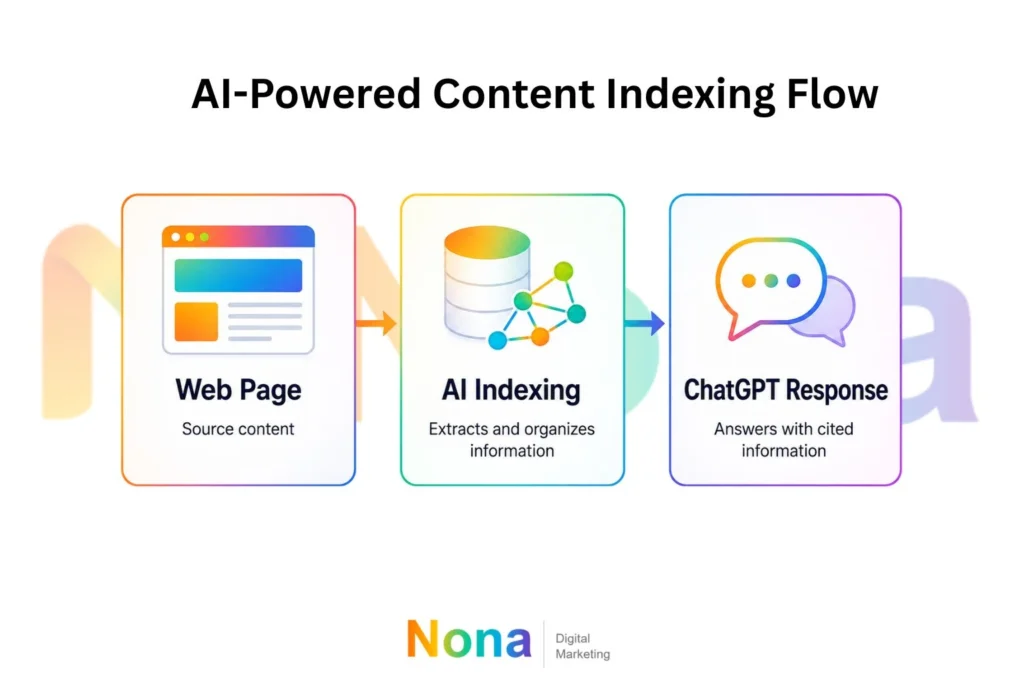
There is also the growing role of Retrieval-Augmented Generation (RAG), where AI systems retrieve live web content before answering, a technique OpenAI has built into how ChatGPT processes and surfaces information. In these pipelines, structured content is easier to chunk, rank, and extract.
A page with logical H2 and H3 headings gives the retrieval system clear anchors to identify what each section is about, something Google’s own documentation on structured content has long emphasized as a factor in how pages are understood and indexed.
In short: headings act as signposts that help AI understand the intent and scope of each section of your content.
If you want to go deeper on producing the kind of content AI models trust and reference, read our guide on how to create AI content the right way.
How H2 headings signal main topics to AI
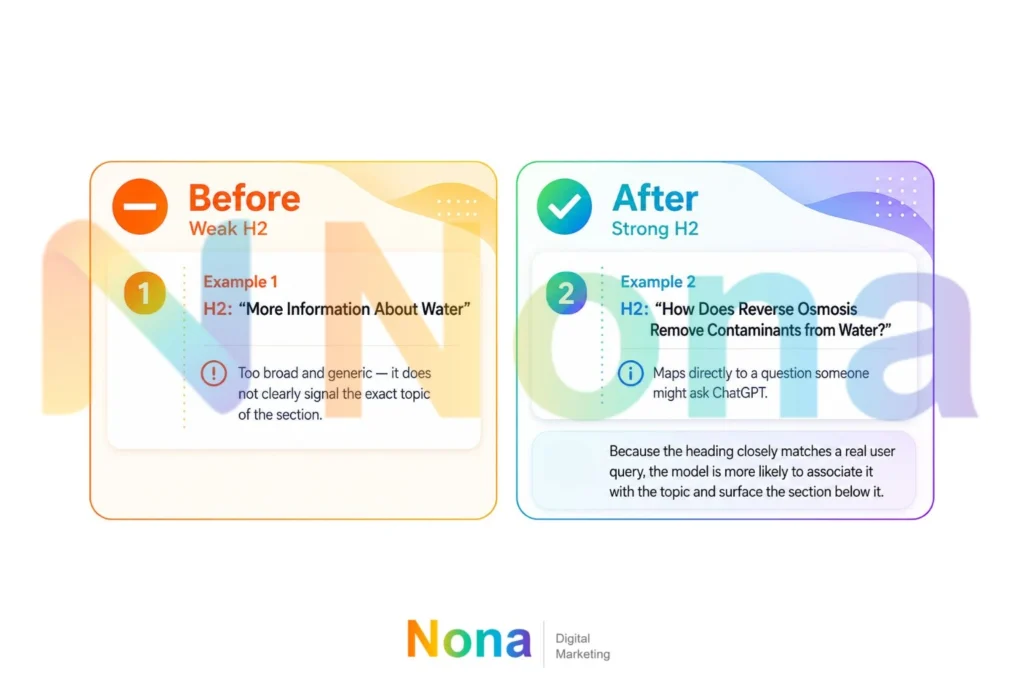
H2 headings define the primary topics of a page. They tell both search engines and AI models: “This section answers a specific question or covers a specific concept.”
When ChatGPT needs to answer a question, it looks for content that clearly addresses that question. An H2 heading phrased as a question or a direct statement of a concept gives the AI a clean signal that the section below is relevant.
Characteristics of effective H2 headings for AI visibility
- They match the language users actually use when asking questions
- They are specific enough to cover one idea, not vague enough to mean anything
- They appear at consistent intervals so the AI can chunk the content into discrete topics
- They use natural phrasing over keyword-stuffed language
Example:
How H3 Headings Help ChatGPT Extract Specific Details
If H2s define the topic, H3s define the specific aspects within that topic. This hierarchy is critical because AI models often need to extract a narrow piece of information, not a full section.
H3 headings allow AI to drill into a subsection without pulling the entire parent section. This means your content can be cited more precisely, and more of your answers can be referenced in a single AI response.
Why specificity in H3s increases citation likelihood
When ChatGPT answers a multi-part question, it often stitches together information from different parts of a page or different sources. H3 headings that label specific sub-answers make it easier for the AI to isolate and quote the right piece.
Consider the difference between these two approaches:
Without clear H3 structure: A long block of text under one H2 covering five subtopics. The AI has to parse unstructured prose to find any specific answer.
With clear H3 structure: Each subtopic gets its own H3 label. The AI can identify exactly which block answers which part of the query.
H3 headings as answer fragments
Think of each H3 section as a potential standalone answer. If a user asks ChatGPT a narrow question and you have an H3 that directly addresses it, followed by a concise, well-written paragraph, that section becomes a strong candidate for citation.
The Heading Hierarchy That AI Models Prefer
AI language models process HTML structure when indexing or retrieving content. A logical, consistent heading hierarchy communicates content relationships clearly.
The recommended pattern is:
- H1: Page title (one per page, defines the overall topic)
- H2: Major sections (each covering one primary subtopic)
- H3: Subsections within each H2 (covering specific aspects, steps, or examples)
- H4 (optional): Further granularity within H3 sections when needed
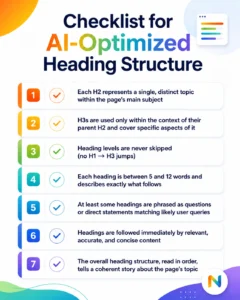
Skipping levels, such as jumping from H1 directly to H3, disrupts the logical structure. This makes it harder for AI to understand the relationship between sections and reduces the likelihood that any individual section will be cleanly extracted and cited.
Writing Headings That Match AI Query Patterns
One of the most practical ways to improve your heading structure for AI citations is to write headings the way people ask questions. ChatGPT answers questions, so if your headings mirror the way questions are phrased, your content becomes structurally aligned with the kinds of queries the AI is responding to. This is also a good reminder that SEO is never just about keywords, structure, intent, and context matter just as much.
Question-based H2s
Phrasing H2 headings as questions is one of the most effective strategies. It creates a direct match between the user’s query and your heading.
Examples:
- “What Are the Benefits of Intermittent Fasting?”
- “How Long Does It Take to Learn Python?”
- “Is Collagen Supplementation Backed by Science?”
These headings signal to the AI: “The text that follows answers this specific question.”
Statement-based H2s for definitional content
For content that defines or explains concepts, a clear declarative statement often works better than a question:
- “The Three Main Types of Machine Learning”
- “How the Blood-Brain Barrier Works”
- “The Difference Between RAM and ROM”
These headings establish the topic with enough precision that the AI can identify the section as relevant to related queries.
H3s as supporting evidence and detail
H3s work best when they provide the specific evidence, steps, or details that support the H2 topic. Treat them as the parts of the answer, not just organizational labels.
H2: How Does Sleep Affect Athletic Performance?
H3 examples:
- The Role of REM Sleep in Muscle Recovery
- How Sleep Deprivation Reduces Reaction Time
- Recommended Sleep Duration for Endurance Athletes
Each H3 narrows the topic and creates a discrete answer block that can be individually cited.
Writing headings that match aI query patterns
AI models parse headings to understand the topic of a section before reading its content. This means that headings need to be clear and concise, not clever, not vague, and not overloaded with information.
Optimal H2 heading length
Between 5 and 12 words is generally ideal. Long enough to be specific, short enough to be parsed quickly.
Too short: “Benefits” (no context) Too long: “The Many Documented Benefits of Regular Morning Exercise on Both Mental and Physical Health According to Recent Research” Just right: “The Mental and Physical Benefits of Morning Exercise”
Optimal H3 heading length
H3s can be slightly shorter, 4 to 10 words, since they operate within the context already established by the H2.
Common heading mistakes that reduce AI visibility
Understanding what not to do is just as important as knowing best practices.
Using headings as decoration, not navigation
When writers use H2 and H3 headings purely for visual styling, without them serving a navigational or semantic function, the content loses structural integrity. AI models can detect poorly structured hierarchies and may deprioritize them.
Vague headings that don’t indicate content
Headings like “Introduction,” “Overview,” or “More Details” give AI no signal about what the section contains. These are missed opportunities to create clear topic anchors.
Inconsistent hierarchy
Mixing H2 and H3 arbitrarily, based on how something looks rather than what it means, breaks the logical structure. AI models that parse heading hierarchies to understand relationships between ideas are confused by inconsistent nesting.
Keyword stuffing in headings
Packing headings with keywords in ways that feel unnatural actually makes them harder for AI to process and match to real queries. Write for clarity first; relevance will follow.
Practical checklist for AI-Optimized heading structure
Use this checklist when reviewing your content:
Structure your content, earn your citations
Heading structure is one of the clearest signals you can give AI models about what your content covers and how it’s organized. H2 headings define your main topics; H3 headings carve those topics into precise, citable answer fragments.
As AI-powered search and chat tools become a primary way people discover information, content that speaks the language of AI retrieval, clear hierarchy, question-aligned headings, and logical structure, will have a meaningful advantage over content that does not.
The good news is that what works for AI citation also works for human readability. A well-structured page with logical, descriptive headings is easier for everyone to navigate, whether they’re a person skimming an article or a language model extracting an answer. Pair that structure with evergreen content, topics that stay relevant over time, and you create pages that get cited by AI not just today, but for years to come.
Here’s the adapted version for this article:
If your content is well-structured but still isn’t getting cited by AI or ranking where it should, it’s time to look at the bigger picture. At Nona Digital Marketing, we work alongside your team to audit your heading structure, content architecture, and SEO strategy, and turn your pages into sources that both Google and AI actually reference. Get in touch to learn more.
Looking to grow your business with SEO?
Get a strategy tailored to your business and start generating consistent traffic..