
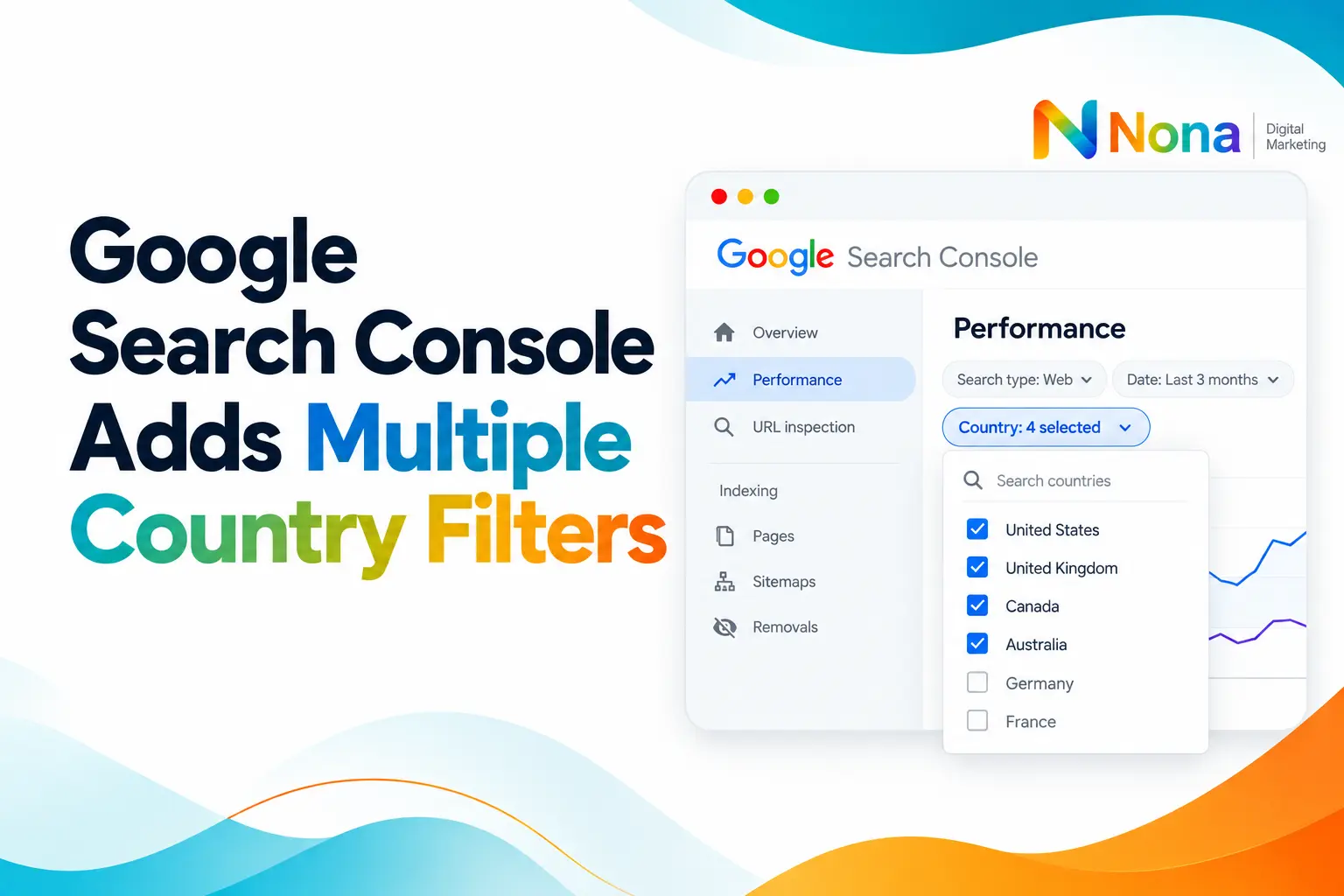
Google Search Console has introduced a useful update for SEO professionals, website owners, and digital marketers managing international websites. It is now possible to select multiple countries at the same time when filtering data in the Search Console Performance report.
The change was reported yesterday (October 6, 2026) and removes a limitation that made international performance analysis more cumbersome. Instead of being restricted to viewing one country at a time, users can now select several countries and analyze their combined search performance.
While this may look like a relatively small interface update, it can have a meaningful impact on international SEO analysis and reporting.
Businesses operating across multiple countries rarely evaluate their SEO performance one market at a time. They may want to analyze English-speaking countries together, combine several European markets, monitor countries within the same commercial region, or understand the overall organic performance of their priority international markets.
The new multiple-country filtering option makes these analyses easier to perform directly inside Google Search Console.
Table of Contents
- What is the new multiple-country filter in Google Search Console?
- How to filter multiple countries in Google Search Console
- Why the new country filter matters for international SEO
- How to analyze multiple countries in Google Search Console
- Multiple-country filtering vs. individual country analysis
- How this Google Search Console update can improve international SEO strategy
- My analysis about the new Google Search Console filter
What is the new multiple-country filter in Google Search Console?
The new functionality expands the country filtering options available within the Google Search Console Performance report.
Previously, country filtering was primarily useful for isolating individual markets. With the update, users can select multiple countries and see their combined performance.
This means an international company could, for example, select the United States, Canada, the United Kingdom, and Australia to analyze its organic search visibility across several English-speaking markets.
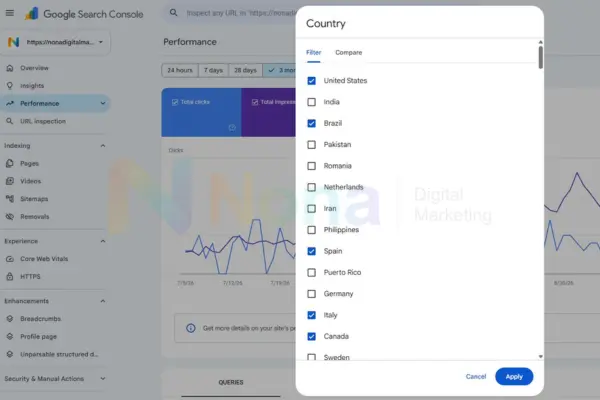
A company targeting Portuguese-speaking audiences could similarly analyze Brazil and Portugal together.
Google’s documentation confirms that country is an established dimension within Search Console data and can be used to understand where search traffic originates.
For SEO teams managing websites with significant international visibility, the new interface makes this dimension considerably more flexible.
How to filter multiple countries in Google Search Console
Using the new feature is straightforward.
Open Google Search Console and navigate to your website’s Performance report.
From there, choose the Country filter. Instead of selecting only one country, you can now select multiple countries that you want to include in the analysis and apply the filter.
Search Console will then display performance based on the selected markets.
You can use the resulting report to evaluate metrics such as clicks, impressions, click-through rate, and average position for the selected group of countries. Google has also been expanding Google Search Console performance reporting, giving SEO professionals more ways to understand how their websites appear across different search experiences.
Google describes Search Console as a tool for monitoring how pages perform in Google Search and recommends periodically analyzing search traffic through its Performance reports.

Why the new country filter matters for international SEO
International SEO often requires analyzing search performance across groups of markets rather than individual countries.
Consider an ecommerce company selling products across Europe. Its marketing team may have one strategy covering Germany, Austria, and Switzerland, while another strategy focuses on the United Kingdom and Ireland.
Previously, analyzing these groups could require separate country views or additional work outside Search Console.
The ability to select multiple countries provides a faster way to create meaningful market segments directly within the platform.
This can be particularly valuable for international SEO consultants and in-house teams that regularly prepare regional performance reports for clients, executives, or other stakeholders.
Instead of organizing reporting exclusively around individual countries, SEO professionals can create views that more closely reflect the company’s actual international strategy.
How to analyze multiple countries in Google Search Console
There are several ways SEO teams can take advantage of the new filtering functionality.
Analyze countries that share the same language
One of the most obvious applications is grouping countries by language.
An English-language website may receive traffic from the United States, United Kingdom, Canada, Australia, Ireland, and other markets. Similarly, Spanish content can attract visitors from Spain and numerous Latin American countries.
Combining relevant markets can provide a high-level view of how content performs across users searching in the same language.
However, language and country should not be treated as interchangeable concepts. Search behavior, terminology, competition, and user intent can differ significantly between countries that share a language.
For this reason, the combined view should complement rather than replace individual country analysis.
Group your most important international markets
Another useful approach is to group countries according to business importance.
Imagine that a global company has identified five markets as its primary international growth opportunities. Those markets may not share the same language or geographic region, but they belong to the same commercial priority group.
With multiple-country filtering, the SEO team can monitor the combined organic search performance of those strategic markets.
This creates a Search Console view that is better aligned with business objectives.
Compare regional SEO performance
The feature can also help with regional analysis.
SEO teams may want to group selected European, Asian, or Latin American markets to understand broader regional trends.
This could help identify whether a decline in organic traffic is isolated to a particular market or appears across several strategically related countries.
The same approach can be used when investigating growth.
If impressions are increasing across a group of countries, SEO teams can then drill down into individual markets, pages, and queries to identify where that growth is coming from.
Improve international SEO reporting
Reporting is another area where this update can save time.
Many international SEO reports are designed around business regions rather than individual countries.
Being able to create these segments directly in Search Console can reduce some of the manual work involved in combining country-level data.
For more sophisticated reporting or automated analysis, Google also provides the Search Console API, which supports country as a dimension for Search Analytics data.
Multiple-country filtering vs. individual country analysis
The new feature is useful, but SEO professionals should be careful when interpreting aggregated data.
Suppose organic clicks increase by 15% across five selected countries. At first glance, the result appears positive.
However, a closer analysis might reveal that one large market grew by 30% while three smaller markets actually declined.
Looking only at the combined data could hide those differences.
A better workflow is therefore to use the multiple-country filter for high-level analysis and then investigate individual countries when an important trend appears.
This gives SEO teams both the broader strategic view and the market-level detail required to make informed decisions.
How this Google Search Console update can improve international SEO strategy
The real value of this update is not that Google Search Console suddenly provides an entirely new type of data. Country information was already an important part of Search Console reporting.
What has improved is the flexibility with which SEO professionals can analyze that data.
That distinction matters.
International businesses often organize their strategies around regions, languages, priority markets, commercial territories, and audience groups. For businesses operating in competitive local markets, working with an experienced SEO company in Miami can also help turn Search Console data into actionable strategies based on local and international search performance.
The update also comes as Google continues expanding Search Console’s reporting capabilities. In September 2026, for example, Google introduced reporting for web multimodal search, covering discovery through experiences such as Google Lens, Circle to Search, image uploads to Google Search, and Chrome’s “Search this image” functionality.
SEO reporting is therefore becoming increasingly multidimensional, making flexible segmentation even more important.
My analysis about the new Google Search Console filter
The ability to analyze multiple countries in Google Search Console is a relatively small update, but it solves a practical problem for international SEO professionals.
It makes it easier to group strategic markets, analyze countries sharing a language, monitor regional performance, and create international SEO reports that better reflect how global businesses actually operate.
At the same time, aggregated country data should not replace individual market analysis. The strongest approach is to use the new filter for identifying broader trends and then investigate individual countries, queries, and pages when deeper analysis is required.
For websites operating across multiple international markets, the new Google Search Console country filter is definitely worth adding to the SEO reporting workflow.
Need help with SEO?
SEO consulting and monthly SEO plans.