
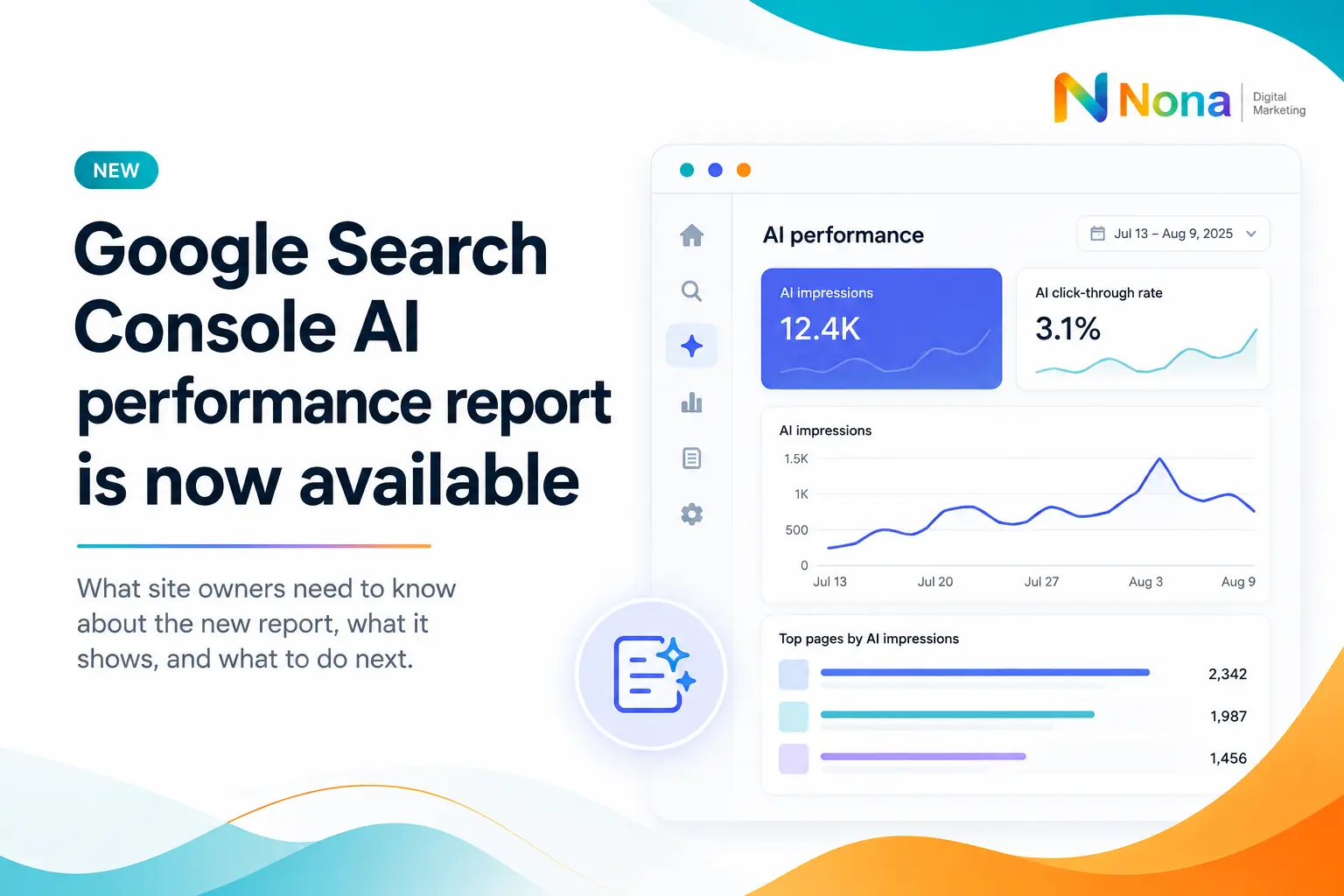
Google Search Console AI report is a new reporting feature designed to give website owners more visibility into how their content appears across Google’s AI-powered search experiences. For publishers, SEOs, and businesses tracking the impact of AI on organic discovery, this is an important development, even though the current reporting remains limited.
The new reporting allows Search Console users to identify pages that have received impressions through Google’s AI search experiences. This gives site owners a first-party signal about which URLs Google is surfacing when AI-generated search results are involved.
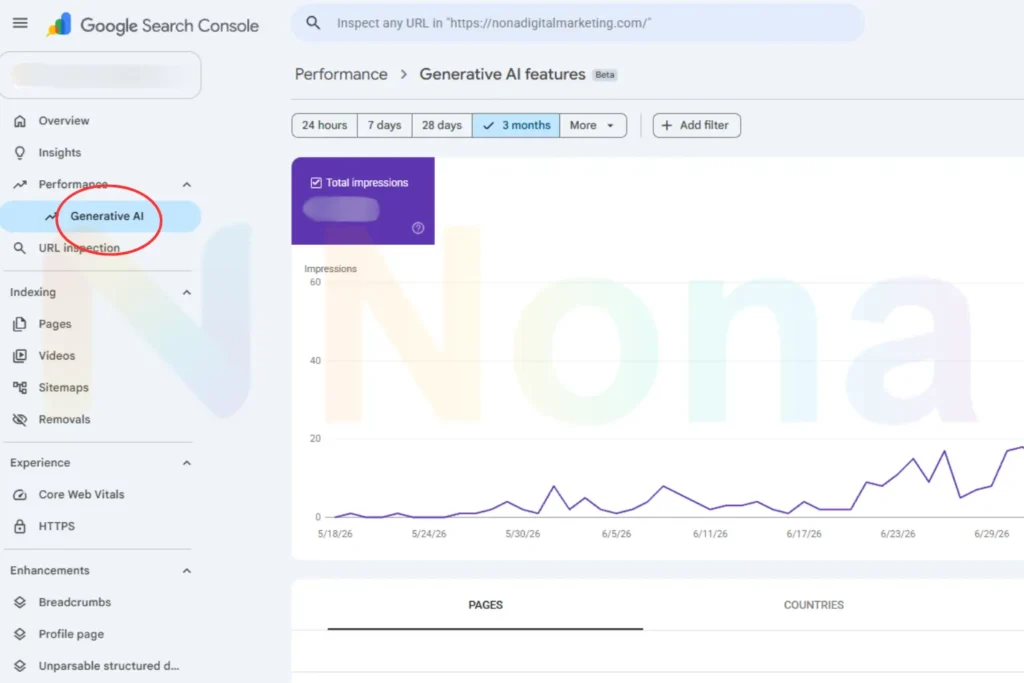
Table of Contents
- What does the Google Search Console AI report show?
- The biggest limitation: Impressions without enough context
- Why AI click data matters
- AI visibility is becoming an SEO metric of its own
- AI Mode is also changing search behaviour
- What Google says about AI search traffic
- What SEOs should do with the new data
- Google needs to give publishers more transparency
- What the Google Search Console AI report means for SEO
What does the Google Search Console AI report show?
The most useful information currently available in the Google Search Console AI performance report is relatively straightforward: which pages on your website received impressions from Google’s AI-powered search features.
That alone can be valuable.
If a particular article, product page, or landing page repeatedly receives AI impressions, it suggests that Google considers the page relevant enough to use or surface within AI-assisted search journeys.
For SEO teams, this creates a new dataset for identifying content that performs well beyond the conventional blue-link search results.
The report can potentially help answer questions such as:
- Which pages are gaining visibility through AI search?
- Are informational articles receiving more AI exposure than commercial pages?
- Which content topics appear particularly compatible with AI-driven discovery?
- Does updating or expanding a page eventually increase its AI visibility?
These are increasingly important questions as search behavior evolves.
The biggest limitation: Impressions without enough context
The problem is that the report currently provides only part of the picture.
Seeing that a URL received AI impressions is useful, but an impression alone does not explain why the page appeared or what happened afterward.
The most important missing dimensions are the queries that triggered those impressions and sufficiently granular click/performance information.
Without query-level data, an SEO professional might know that an article received thousands of AI impressions but still not know whether users were searching for a broad informational topic, asking a highly specific question, comparing products, or researching something with commercial intent.
That makes optimization considerably harder.
Traditional Search Console data is powerful precisely because SEOs can connect queries, pages, impressions, clicks, positions, countries, devices, and dates. AI visibility reporting needs a similarly useful relationship between user intent, citation/appearance, and resulting traffic.
Why AI click data matters
AI-powered search creates a different user journey from conventional search results.
In traditional Google Search, the journey is relatively straightforward: a user enters a query, sees a search result, clicks it, and visits the website.
With AI search, that journey becomes more complex. The user may ask a question, receive an AI-generated answer, see a source cited, and only then decide whether to click through to the website.
The critical word is possible.
An AI answer may satisfy the user’s question without requiring a visit to the original publisher. Consequently, measuring impressions without understanding resulting clicks makes it difficult to determine the actual business value of AI visibility.
A page could receive substantial AI exposure while generating relatively little referral traffic. Conversely, another page might appear less frequently but attract highly qualified visitors.
Those two outcomes require very different SEO strategies.
AI visibility is becoming an SEO metric of its own
Despite its limitations, the introduction of dedicated AI-related reporting is significant.
For years, SEO performance has primarily revolved around rankings, impressions, clicks, and conversions. AI search introduces another layer: citation and answer visibility.
Instead of asking only:
“Does my page rank?”
SEO teams increasingly need to ask:
“Does Google consider my content useful enough to incorporate into an AI-generated search experience?”
This shifts part of SEO strategy toward creating content that can be easily understood, extracted, summarized, and connected to specific user questions.
Clear definitions, concise explanations, strong topical coverage, original information, structured content, and trustworthy sourcing may therefore become even more important.
AI Mode is also changing search behaviour
Reporting changes should also be considered alongside changes in how people actually use Google.
AI interfaces encourage longer, conversational queries and allow users to refine their searches through follow-up questions rather than repeatedly returning to a traditional results page.
We explored this change in more detail in our article about ai mode search behaviour, including what conversational search could mean for keyword research and SEO strategy.
Understanding this behavioral shift is important because traditional keyword metrics may not fully represent how users interact with AI-powered search.
What Google says about AI search traffic
Google has also published documentation explaining how AI features interact with website traffic and Search Console measurement.
According to Google, traffic from AI features such as AI Overviews and AI Mode is included within Search Console’s overall Web search reporting, although the exact reporting capabilities and feature availability can evolve as Google develops these experiences.
For the latest first-party information, site owners should consult Google’s official Search Console documentation rather than relying exclusively on third-party AI visibility tools.
This distinction matters because Google controls both the search experience and the first-party measurement infrastructure behind Search Console.
What SEOs should do with the new data
Even with limited information, there are several practical ways to use AI impression data.
First, identify pages receiving disproportionately high AI visibility. Analyze what those pages have in common: content format, subject, depth, structure, authority signals, freshness, and the types of questions they answer.
Then compare those pages with similar content receiving little or no AI exposure.
This can reveal patterns worth testing across your site.
You should also continue monitoring conventional Search Console metrics. A rise in AI impressions becomes considerably more interesting when evaluated alongside changes in total organic impressions, clicks, click-through rate, branded searches, conversions, and traffic to the same URLs.
Most importantly, avoid treating AI impressions as an end goal.
Visibility matters, but business outcomes matter more.
Google needs to give publishers more transparency
The new reporting is a useful first step, but publishers need considerably more information to understand the economics of AI-powered search.
Ideally, Search Console would eventually provide AI-specific data for impressions, clicks, CTR, queries, pages, countries, devices, and AI search feature types.
That would allow website owners to answer a much more important question:
Is AI search creating meaningful discovery and traffic, or is Google increasingly consuming publisher content while keeping users inside its own search experience?
Without sufficiently granular data, that question remains difficult to answer.
What the Google Search Console AI report means for SEO
Google exposing AI-related visibility inside Search Console acknowledges something SEO professionals already know: AI search is becoming a measurable part of organic search.
The current implementation may feel underwhelming because page-level impressions without deeper query and click context provide limited actionable intelligence.
Still, the direction is important.
Search Console is gradually moving from measuring only traditional search performance toward helping publishers understand their presence within AI-powered discovery.
For SEO professionals, the challenge now is not simply tracking rankings. It is understanding where content appears, why AI systems choose it, whether users click through, and ultimately whether that visibility produces value.
Until Google provides more granular reporting, AI impressions should therefore be treated as an additional visibility signal—not as a replacement for clicks, conversions, or traditional organic performance.
As Google continues to expand AI Mode and AI-driven results, brands that adapt their SEO strategy early will be better positioned to protect organic visibility and capture new search opportunities.
If you need help understanding how AI search is affecting your website, improving your organic visibility, or building an SEO strategy for the next generation of search, Nona Digital Marketing can help.
From technical SEO and content strategy to AI search visibility and performance analysis, we help businesses turn search changes into measurable growth.
Need help improving your visibility in AI search?
Improve your visibility across AI-generated answers, Bing AI Performance reports, and search engines with content strategies built for the next generation of SEO.