
AI mode search behavior is changing the way people use Google. Search is no longer just a place where users type a keyword, scan a list of links, and click through to a website.
That version of search still exists, of course. But it is no longer the whole picture.
With AI-powered search experiences becoming part of everyday behavior, Google is increasingly acting less like a search engine in the traditional sense and more like an assistant, recommendation engine, decision-making layer, and task manager.
According to recent U.S. data, 1 billion people are already using AI Mode. And what they are searching for says a lot about where search is going next.
The most common use cases include:
- Creative content generation, including text and images
- General informational research
- Beauty product recommendations
- Bar, restaurant, and café recommendations
- Health, fitness, and nutrition recommendations
- Media suggestions, such as TV shows, games, music, and streaming content
- Career and personal finance advice
- Tutorials for everyday activities
- Programming and technology help
- Travel planning, including flights, hotels, and itineraries
These categories may look broad at first. But for anyone working with SEO, content strategy, brand positioning, or digital growth, they reveal something much deeper.
This AI mode search behavior matters because it shows that users are turning to Google not only for information, but also for recommendations, decisions, and task completion.
They show that people are not only using Google to find information. They are using it to create, compare, choose, plan, learn, buy, and act.
That shift changes everything.
Table of Contents
- SEO can’t be only about keywords anymore
- Google’s AI is becoming a recommendation hub
- Some categories are more exposed to AI search than others
- Search is no longer just about finding information
- The click is becoming optional
- Google is turning into a task manager
- Tasks that once required clicks don’t always need them anymore
- What AI Mode search behavior means for brands
- The future of SEO is more strategic than ever
SEO can’t be only about keywords anymore
For years, SEO strategies have been built around keywords, a modern SEO strategy goes beyond keywords.
Find what people search for. Create pages that match those searches. Optimize titles, headings, internal links, and content structure. Build authority. Earn rankings. Win clicks.
That model still matters, but it is no longer enough.
AI-powered search changes the relationship between the query and the result. Instead of simply matching a user’s words to a list of pages, Google is trying to understand the full context behind the request.
The user may not be looking for a page. They may be looking for an answer, a recommendation, a shortlist, a summary, a comparison, a plan, or even a completed task.
That means brands need to optimize for intent, usefulness, credibility, and context, not just keywords.
For example, a beauty brand should not only ask, “What keywords are people searching for around moisturizer?” It should also ask:
- What questions does someone have before choosing a moisturizer?
- What skin concerns are they trying to solve?
- What comparisons matter to them?
- What ingredients are they confused about?
- What would make an AI-generated answer trust this brand enough to mention it?
The future of SEO is not keyword stuffing with better formatting. It is becoming the most useful, trustworthy, and clearly understood source in your category.
Google’s AI is becoming a recommendation hub
One of the most important signals in this data is the presence of recommendation-heavy categories.
Beauty products. Restaurants. Cafés. Health and fitness. Media. Travel. Personal finance. Career advice.
These are not simple informational searches. They are decision-making searches.
People are asking Google to help them choose.
That is a major change for brands because recommendation visibility is different from traditional ranking visibility. In classic search, a brand might aim to rank number one for “best moisturizer for dry skin” or “best cafés in Austin.”
In an AI-powered experience, the user may never see a traditional list of ten blue links. Instead, they may receive a curated answer with a few suggested options, a comparison, and a direct recommendation based on their context.
That makes brand presence inside AI-generated answers extremely valuable.
It also means brands need to think beyond their own websites. AI systems may pull signals from reviews, product pages, third-party websites, local listings, structured data, social proof, expert mentions, and broader brand authority.
A restaurant, for example, may not win only because its website is optimized. It may win because its menu is clear, reviews mention specific use cases, photos are updated, local listings are complete, and other websites describe it consistently.
A skincare brand may not be recommended because it repeats the same keyword across dozens of pages. It may be recommended because its product information is specific, ingredient claims are clear, reviews answer real objections, and authoritative sources validate its positioning.
AI search rewards clarity. It also rewards brands that are easy to understand, compare, and recommend.
Make sure your website is ready for the future of search.
We’ll identify the technical, content, and visibility issues that may be holding your website back in traditional search and AI-generated answers.
Some categories are more exposed to AI search than others
Not every industry will feel the impact of AI-powered search in the same way or at the same speed.
The categories listed in the data are especially exposed because they involve frequent decision-making, comparison, and personal context.
Beauty, food, health, fitness, entertainment, travel, finance, career, and technology are all areas where people often want help narrowing down options.
They do not just want information. They want guidance.
This creates both risk and opportunity.
The risk is that brands in these categories may lose clicks as Google answers more questions directly inside the search experience. If the user gets a complete recommendation, comparison, or itinerary without visiting a website, traditional organic traffic may decline.
The opportunity is that brands can become part of the answer.
For many companies, the new challenge is not only, “How do we rank?” It is also, “How do we become the option that AI systems understand, trust, and recommend?”
This requires a broader SEO mindset.
A travel company needs to think about destination guides, itinerary structures, hotel comparisons, local expertise, pricing clarity, and real traveler intent.
A fitness brand needs to think about beginner questions, safety, personalization, goal-based content, and credible explanations.
A software company needs to think about tutorials, troubleshooting, documentation, comparisons, use cases, and developer-friendly clarity.
The brands most exposed to AI search are often the same brands with the most to gain from adapting early.
Search is no longer just about finding information
One of the biggest mistakes brands can make is assuming that Google is still mainly an information retrieval tool.
It is not.
Modern Google is increasingly becoming a place where people complete parts of their lives.
They ask it what to buy.
They ask it where to go.
They ask it what to watch.
They ask it how to fix something.
They ask it how to plan a trip.
They ask it how to write something.
They ask it how to understand a health, career, or financial decision.
Search has become more active.
In the past, a query often represented the beginning of a journey. A user searched, clicked, read, compared, and eventually acted somewhere else.
Now, the search experience itself can absorb more of that journey.
For example, someone planning a trip used to search for destination ideas, then open several blogs, compare hotels, check flights, read itineraries, and slowly build a plan.
With AI Mode, that same person may ask for a five-day itinerary, with hotel suggestions, restaurant recommendations, estimated travel times, and activity ideas. The output is not just information. It is a working plan.
That changes what content needs to do.
A travel article cannot only be “10 Things to Do in Lisbon.” It needs to be structured, practical, specific, and useful enough to become part of an AI-generated itinerary.
A finance article cannot only define what an emergency fund is. It needs to help different types of readers understand how much they may need, what trade-offs exist, and what steps to take next.
A product page cannot only list features. It needs to explain who the product is for, who it is not for, how it compares, and what problem it solves.
Modern search is not only answering, “What is this?” It is increasingly answering, “What should I do next?”
The click is becoming optional
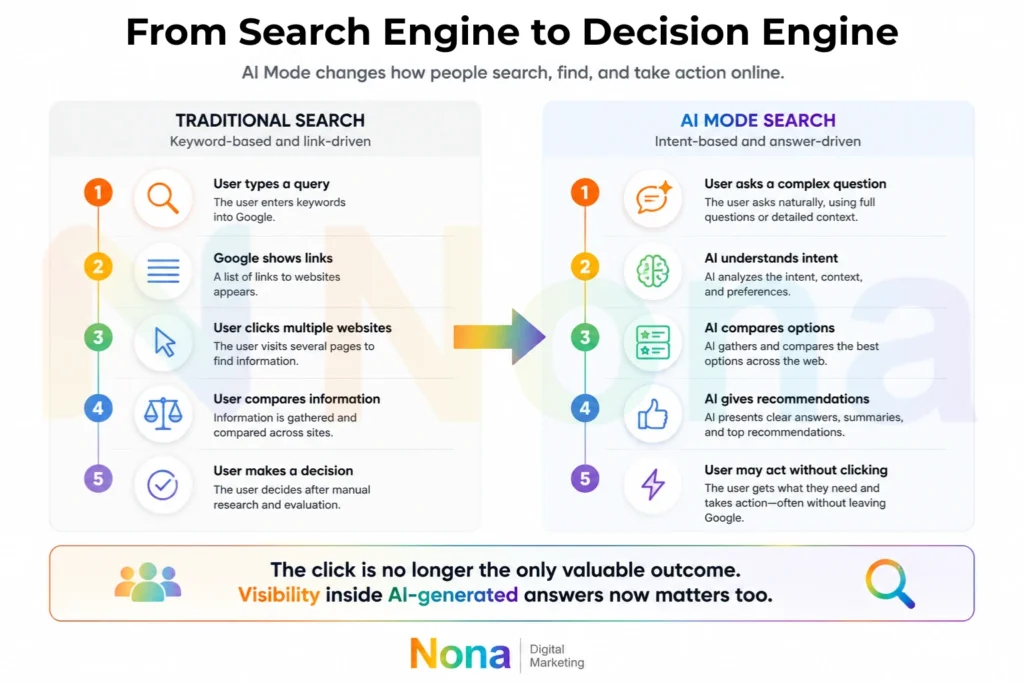
Search has been shifting toward fewer traditional clicks. The goal of Google’s AI experience is often to deliver a complete answer directly on the results page. In many cases, the user may not need to click.
Google’s search results have been moving toward answer-first experiences, but that does not mean websites are dead. It does not mean SEO is dead. But it does mean the value of SEO is changing.
For years, organic success was measured mainly through rankings, impressions, clicks, and conversions. Those metrics still matter, but they are no longer the full story.
A brand may influence a decision without receiving the click.
A restaurant may be recommended in an AI answer.
A product may appear in a comparison.
A travel brand may inform an itinerary.
A software company may be cited as a solution.
A publisher may shape the answer even if the user does not visit the page.
This creates a measurement challenge. But it also creates a strategic challenge.
If the click becomes optional, then brands need to care about visibility before the click.
They need to care about being included, summarized, cited, trusted, and recommended.
This does not replace technical SEO, content quality, or authority building. It expands them.
The new question is not only, “How do we get users to our site?” It is also, “How do we make sure our brand is present when AI helps users make decisions?”
Google is turning into a task manager
Another important shift is that Google is becoming more action-oriented.
The data shows people using AI Mode for tutorials, programming help, travel planning, content creation, recommendations, and personal advice. These are not passive searches. They are tasks.
This means Google is moving closer to being a task manager for everyday life.
The user does not simply ask, “best hotels in New York.” They may ask, “Plan a three-day New York trip for two people, close to good restaurants, under a specific budget, with a mix of museums and nightlife.”
The user does not simply ask, “How to meal prep?” They may ask, “Create a high-protein meal prep plan for five weekdays with easy recipes and a grocery list.”
The user does not simply ask, “Resume tips.” They may ask, “Rewrite my resume summary for a product marketing role in a more confident tone.”
In these cases, the search experience becomes part of the execution layer.
This is important because many website visits used to happen during these tasks. A person had to click multiple links to gather enough information to complete the job. Now, AI can reduce that need.
For brands, this means content should be built not only to inform but also to support action.
Good SEO content needs to be more useful, more structured, and more task-oriented.
Instead of only publishing articles that answer isolated questions, brands should create content ecosystems that help users move from question to decision to action.
Tasks that once required clicks don’t always need them anymore
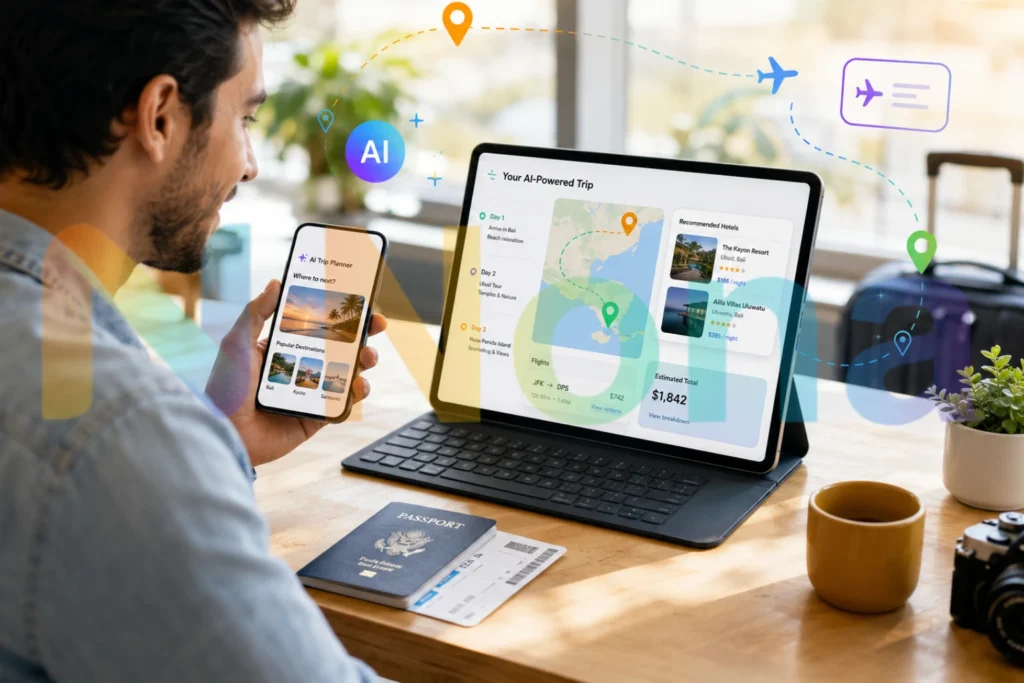
Travel planning is one of the clearest examples.
In the traditional search journey, building an itinerary required multiple clicks. Users needed to visit blogs, hotel sites, map results, restaurant pages, booking platforms, and review websites.
Now, AI can generate a first version of that itinerary instantly.
The same is true for many other categories.
A user can get a skincare routine without visiting five beauty blogs.
A user can get restaurant ideas without opening several local guides.
A user can get a workout plan without clicking into multiple fitness websites.
A user can get code help without opening a developer forum.
A user can get a list of shows to watch without browsing multiple entertainment articles.
This does not eliminate the need for deeper content. In fact, deeper content may become even more important as a source layer. But the role of that content changes.
Content may increasingly feed the answer instead of receiving the visit.
That means brands need to make their information easier for machines and humans to interpret.
Clear headings matter.
Structured data matters.
Specific product details matter.
Author expertise matters.
Freshness matters.
Reviews and reputation matter.
Consistent brand positioning matters.
Original insight matters.
If your content is vague, generic, outdated, or difficult to parse, it becomes less useful in an AI-driven search environment.
What AI Mode search behavior means for brands
These shifts are not entirely new. SEO professionals have been talking about zero-click searches, AI answers, entity optimization, and search intent for years.
But what is changing now is scale. Brands need to think about GEO, AEO, and SEO for AI.
When 1 billion people are using AI Mode, this is no longer a future trend. It is current behavior.
The brands that adapt will not be the ones that simply add “AI SEO” to a strategy deck. They will be the ones that rethink how they show up across the entire decision journey.
That starts with a few practical changes.
First, brands need to move beyond keyword-first planning. Keywords still matter, but they should be treated as signals of intent, not the entire strategy.
Second, content should be built around real user decisions. What does the user need to compare? What objections do they have? What makes one option better than another? What context changes the answer?
Third, brands should invest in authority and trust. AI-generated answers are more likely to rely on sources that appear credible, consistent, and useful across the web.
Fourth, make your website easier for search engines to crawl, companies need to structure their content clearly. Pages should be easy to understand, easy to summarize, and easy to connect to specific user needs.
Fifth, brands need to monitor where AI search is already affecting visibility. Categories like beauty, restaurants, health, fitness, entertainment, finance, career, technology, and travel should pay especially close attention.
Finally, SEO teams need to accept that the click is no longer the only outcome that matters.
Visibility, recommendation, and influence are becoming part of the new organic search value.
The future of SEO is more strategic than ever
It is easy to frame AI-powered search as a threat to SEO. And in some ways, it is. Traffic patterns may change. Click-through rates may decline for some queries. Traditional ranking reports may become less complete.
But this does not make SEO less important.
It makes SEO more strategic.
Brands still need to be discoverable. They still need to be trusted. They still need to answer real questions. They still need to help users make decisions. They still need to communicate clearly with both people and systems.
The difference is that search is no longer just a channel for capturing demand. It is becoming an environment where demand is interpreted, shaped, and sometimes fulfilled before the user ever reaches a website.
That is a major shift.
For brands, the question is no longer just, “Are we ranking?”
The better question is:
When someone asks AI for help in our category, are we part of the answer?
And if we are not, what needs to change?
Because the future of search will not belong only to the brands with the most keywords. It will belong to the brands that are the easiest to understand, trust, recommend, and act on.
For brands, understanding AI Mode search behavior is becoming essential to staying visible in the next phase of SEO. As search becomes more answer-driven, the opportunity is not only to rank but also to be recommended.
Get in touch with Nona Digital Marketing today and let’s turn this shift into stronger search visibility, better content, and smarter SEO performance.