
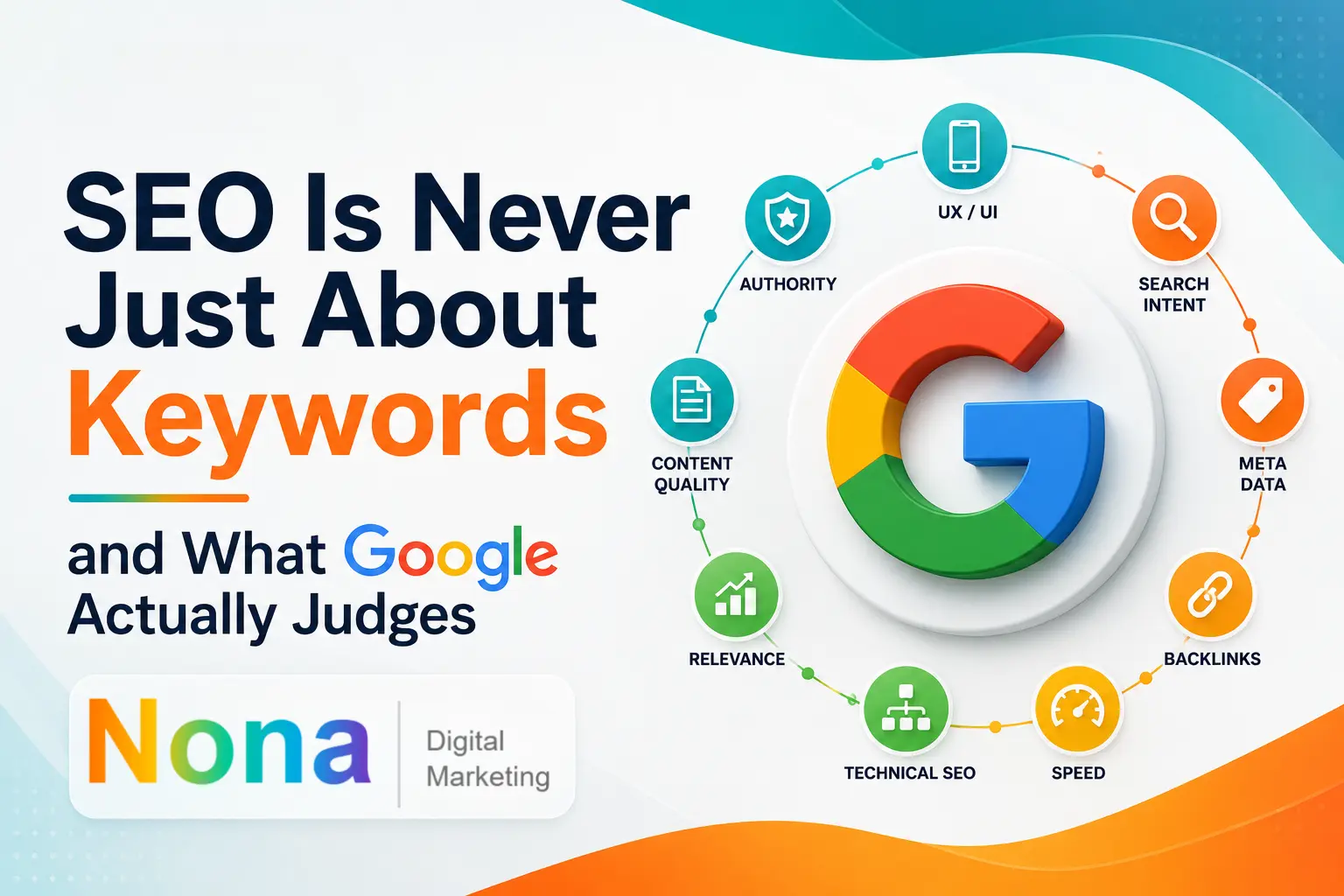
If you’ve been treating SEO like a keyword-stuffing game, you’ve already lost. SEO beyond keywords is the real game, and most websites are playing the wrong one.
Google doesn’t reward the website that uses a phrase the most. It rewards the website that best answers the question, loads the fastest, earns the most trust, and delivers the best experience, every single time.
SEO is a system. Keywords are just one dial on a much larger control panel. And if you only know how to turn that one dial, your competitors who understand the full board will outrank you every time.
In this article, we’re going to break down every dimension Google uses to evaluate your website, organized by category, explained in plain English, and finish with a practical guide on how to create AI-assisted content that Google will actually reward.
Table of Contents
- What Google is really measuring and why keywords are just the beginning
- On-Page SEO: The signals inside your content
- Technical SEO: What Google sees before it reads a word
- User Experience: Google Can Feel When Your Site Is Bad
- Authority Signals: How Google Decides to Trust You
- How to create AI content the right Way, according to Google
- SEO is a system, not a shortcut
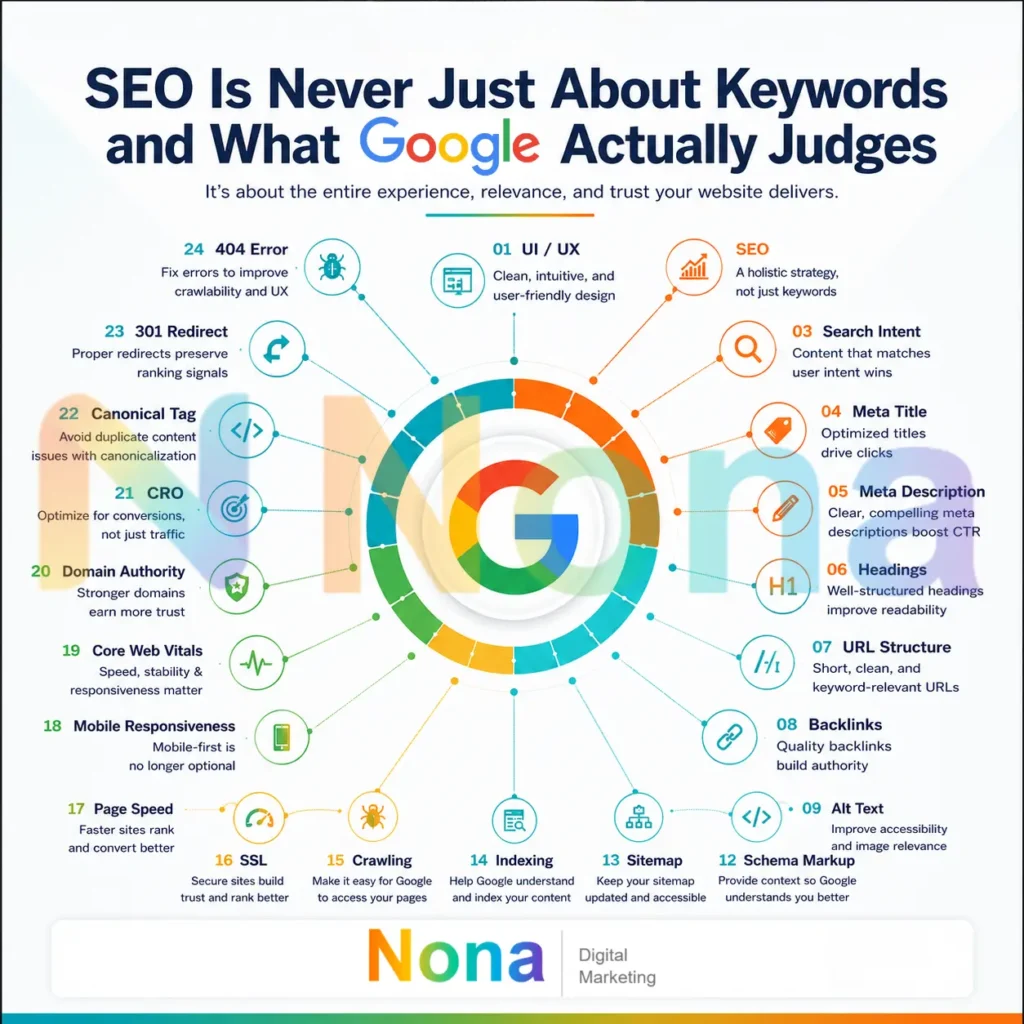
Google’s algorithm evaluates websites across four broad pillars:
- Relevance: Does your content match what the user actually needs?
- Authority: Do other credible sources trust and reference you?
- Experience: Is your website fast, safe, and easy to use?
- Technical Health: Can Google find, read, and index your pages?
Keywords live mostly in the relevance pillar. But the other three? They’re just as important and far more neglected.
Your meta title is still one of the strongest on-page ranking signals. It’s the headline Google reads before anything else. Keep it under 60 characters, lead with your target keyword, and make it compelling enough to earn the click.
Your meta description doesn’t directly affect rankings, but it absolutely affects your click-through rate (CTR), which does. Write it like ad copy: one clear promise, one strong reason to click, under 155 characters.
Headings (H1, H2, H3)
Your H1 should appear once and contain your primary topic. Think of it as your article’s thesis statement. Supporting headings (H2s, H3s) help Google understand your content’s structure and hierarchy, and they help readers skim.
A strong heading structure also improves your chances of earning featured snippets, which are one of the highest-visibility positions on a search results page.
URL Structure
Clean, descriptive URLs perform better than long, parameter-filled ones. Compare:
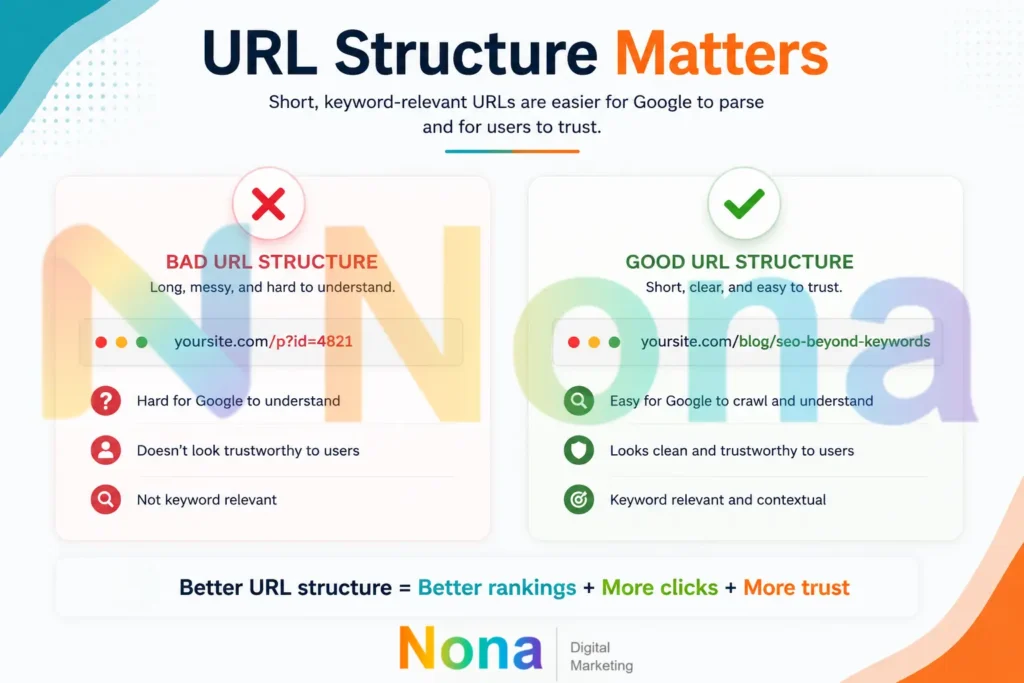
Short, keyword-relevant URLs are easier for Google to parse and for users to trust.
Alt Text
Every image on your site should have descriptive alt text. This serves two purposes: it helps visually impaired users understand the image through screen readers, and it gives Google context about what the image shows. Both factors influence your rankings.
Internal Linking
Internal links are the connective tissue of your website. They pass authority from high-performing pages to newer ones, help Google discover your full content library, and keep readers engaged longer, all of which sends positive engagement signals back to Google.
Crawling and Indexing
Before Google can rank your page, it needs to crawl it (discover it) and index it (store it). If either step fails, you don’t exist in search results, period.
Make sure your important pages are crawlable (not accidentally blocked in your robots.txt file) and have been submitted via your sitemap. It’s important to work with a reliable partner for technical SEO services.
Robots.txt
Your robots.txt file tells Google’s crawlers which pages to visit and which to skip. Misconfigurations here can accidentally block your entire site from Google. Audit it regularly.
Sitemap
A sitemap is essentially a map of your website given directly to Google. It helps ensure all your important URLs get discovered and crawled efficiently, especially valuable for large sites or sites with many new pages.
SSL (HTTPS)
If your website is still running on HTTP, Google has been flagging it as “not secure” since 2018. SSL is a confirmed ranking signal. It also builds user trust, visitors are far less likely to bounce from an HTTPS site.
301 Redirects and 404 Errors
301 redirects tell Google that a page has permanently moved to a new URL. Use them whenever you rename or restructure pages to preserve the ranking authority the old URL had built.
404 errors (page not found) can hurt your crawl budget and create dead ends for users. Monitor for broken links and either fix or redirect them.
Canonical Tags
If you have the same (or very similar) content accessible at multiple URLs, a canonical tag tells Google which version is the “official” one. Without it, Google may split your ranking signals across duplicate pages, or penalize you for thin/duplicate content.
Core Web Vitals
Core Web Vitals are Google’s official user experience metrics. They measure:
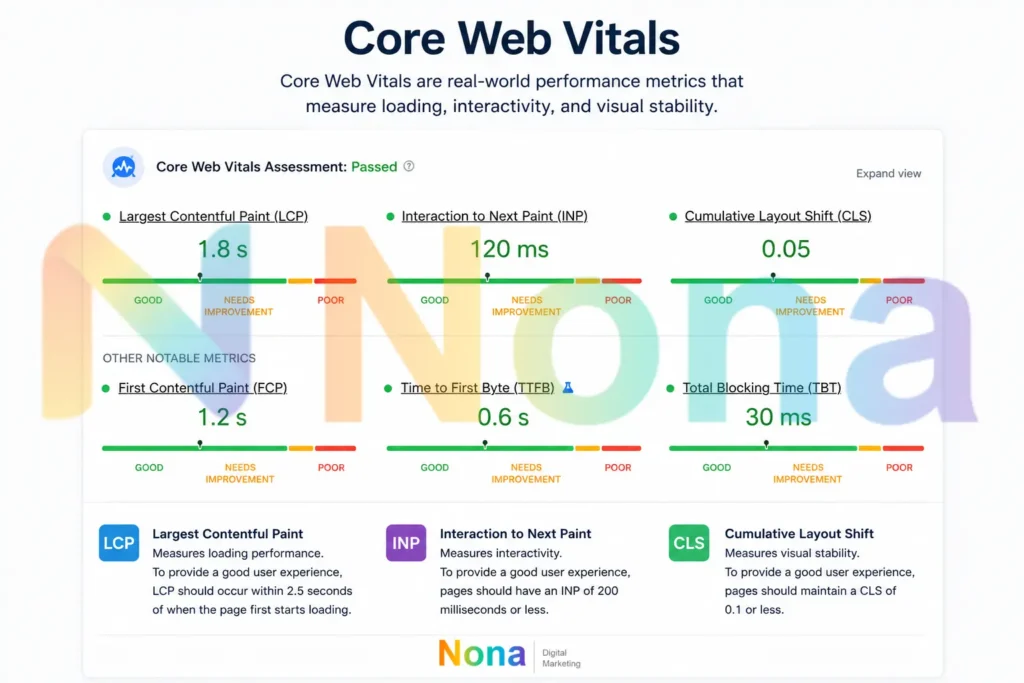
- LCP (Largest Contentful Paint): How fast does your main content load?
- INP (Interaction to Next Paint): How quickly does your site respond to user actions?
- CLS (Cumulative Layout Shift): Does your page jump around while loading?
These are confirmed ranking factors. A slow, janky website will be penalized even if its content is excellent.
Page Speed
Page speed affects both your Core Web Vitals scores and user behavior directly. Studies consistently show that users abandon pages that take more than 3 seconds to load. Compress images, minimize code, use caching, and consider a CDN.
Mobile Responsiveness
Google crawls the web using its mobile-first index, meaning it evaluates the mobile version of your site, not the desktop version. If your site doesn’t work well on phones, your rankings will suffer everywhere.
UI and UX
UI (User Interface) is how your site looks. UX (User Experience) is how it feels to use. Google measures both indirectly through behavioral signals: time on page, bounce rate, scroll depth, and return visits. A confusing layout or cluttered design will drive users away, and those negative signals follow you in the rankings.
Backlinks
Backlinks are links from other websites pointing to yours, remain one of the most powerful ranking factors Google uses. A single link from a high-authority, relevant website can be worth more than dozens from low-quality sources.
Focus on earning backlinks through:
- Publishing genuinely useful, original research
- Guest posting on reputable industry sites
- Creating linkable assets (tools, guides, infographics)
- Getting mentioned in roundups and press coverage
Domain Authority
Domain Authority (DA) is a third-party metric (developed by Moz) that estimates how strong your website’s overall backlink profile is. While Google doesn’t use DA directly, the underlying factors it measures, quality and quantity of inbound links, site age, content depth, absolutely affect your rankings.
Search Intent and CRO
Search intent is the why behind a search query. Google classifies intent as informational, navigational, transactional, or commercial. Ranking for a keyword while mismatching its intent will tank your performance regardless of how optimized your content is.
CRO (Conversion Rate Optimization) isn’t a direct ranking factor, but it’s the reason SEO matters at all. Traffic without conversions is just vanity. Align your content to intent, and your conversions will follow your rankings.
Schema Markup
Schema markup is structured data code that helps Google understand what your content means, not just what it says. Adding schema for articles, FAQs, products, reviews, and events can unlock rich results in search (star ratings, FAQs, breadcrumbs) that dramatically increase click-through rates.
Google’s official stance on AI content is clear: it’s not about who or what wrote the content, it’s about quality.
Content created, reviewed, or assisted by AI that is helpful, accurate, original, and written for humans will rank. Content that is generated purely for search engines, lacks expertise, or adds no real value will not.
Here’s the framework for AI content that Google rewards:
Lead With Expertise
AI is a drafting tool, not a thinking tool. The ideas, angles, and insights should come from you, your experience, your research, your perspective. AI can help you structure and express those ideas. That’s the division of labor Google respects.
Follow E-E-A-T Principles
Google evaluates content through the lens of E-E-A-T: Experience, Expertise, Authoritativeness, and Trustworthiness.
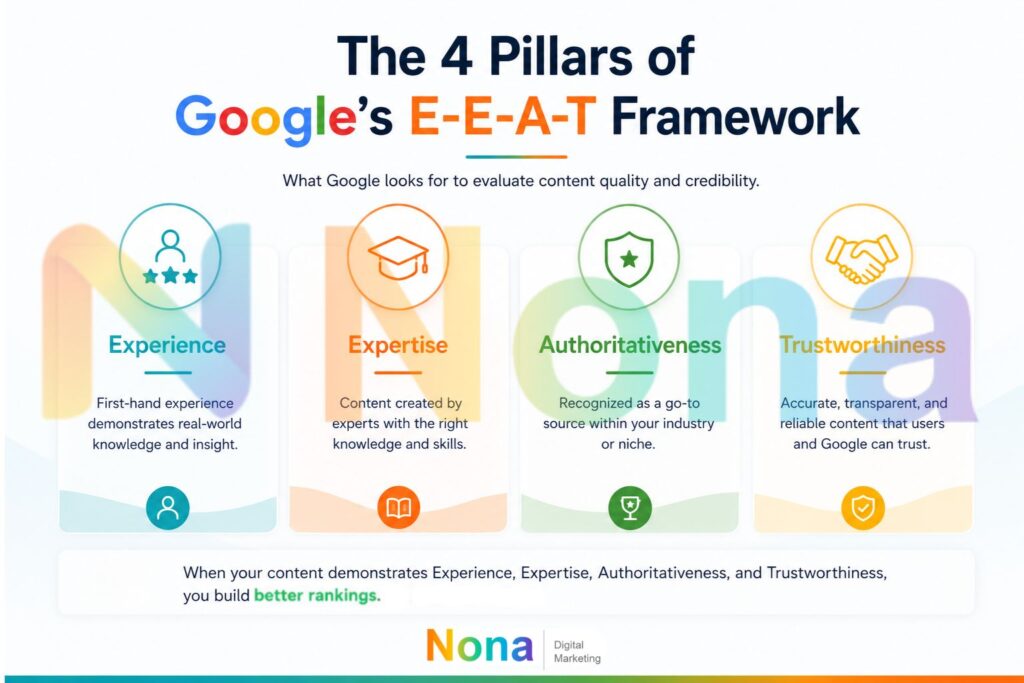
- Add author bios with real credentials
- Cite primary sources and link to them
- Include first-person examples where relevant
- Show your publication and update dates
An AI-drafted article with a verified author, cited sources, and real examples will outperform a human-written article with none of those signals.
Optimize for Search Intent, not just keywords
Before you write anything with or without AI, confirm the search intent behind your target keyword. Look at the top 5 results for that keyword. What format are they using? What questions are they answering? What length are they? Match and exceed that standard.
Edit Aggressively
AI content tends to be generic, padded, and evasive. Your editing job is to:
- Cut filler phrases (“In today’s fast-paced world…”)
- Add specificity (real numbers, named examples, original data)
- Inject voice (opinions, analogies, humor where appropriate)
- Verify every factual claim
The more AI-sounding your final content is, the less it will connect with readers, and the less Google will reward it over time.
Build evergreen content strategically
Evergreen content articles that remain useful and accurate regardless of when they’re read, is the highest-ROI content you can produce. It builds authority over time, earns backlinks passively, and compounds in traffic.
For a deeper dive on how to build a content strategy around evergreen topics, see our complete guide to building an evergreen content.
To make content evergreen:
- Target perennial questions, not trending news
- Use timeless examples
- Schedule regular audits to update data and statistics
- Add internal links as your site grows
Every term in the image at the top of this article, from crawling to schema markup, from SSL to search intent, is a cog in the same machine. Google evaluates all of them together.
The websites that win aren’t necessarily the ones with the biggest budgets or the most content. They’re the ones that understand SEO as a complete system: technically sound, user-focused, authoritative, and consistently relevant.
Keywords will always matter. But they’re the invitation, not the reason someone stays.
Fix your Core Web Vitals. Earn real backlinks. Write content with actual expertise. Learn exactly how to use AI for content SEO without falling into the traps Google penalizes. And make every page on your site something a real person is genuinely glad they found.
That’s what Google rewards. And more importantly, it’s what your audience deserves.
Looking to grow your business with SEO?
Get a strategy tailored to your business and start generating consistent traffic..