

Over the past few weeks, if you follow SEO news or industry discussions on LinkedIn, one topic that has been showing up more and more is llms.txt.
Google has previously said that llms.txt does not serve much practical purpose. But more recently, Lighthouse, Google’s own tool for assessing website quality, started checking whether a site includes one.
Adding an llms.txt file probably will not earn your website more AI citations right now. Google Search has said it is not needed for AI visibility, while Lighthouse frames it more as an emerging convention that may help AI agents understand a site’s structure more efficiently.
So, let’s take a closer look at what llms.txt can actually do, where its limits are, and why the advice around it feels so mixed.

Table of Contents
How does the llms.txt file work?
The llms.txt file is essentially a short, machine-friendly summary of a website’s content, usually written in Markdown.
llms.txt is still a proposed protocol. It has not been broadly adopted across the industry yet. That makes it very different from robots.txt, which is a long-established convention that most crawlers and systems already recognize and follow.
Does the llms.txt actually work?
There is currently no solid evidence that llms.txt improves rankings, AI visibility, or citation frequency. In fact, the evidence we have so far points in the opposite direction.
Google has not indicated that llms.txt is used by Google Search, AI Overviews, or AI Mode. Its official guidance for performing well in AI Search still focuses on the same fundamentals as traditional SEO: helpful content, accessible pages, good user experience, structured data where relevant, and proper preview controls, llms.txt is not listed as a requirement or recommendation in that guidance.
There is also no public confirmation from major AI companies such as OpenAI, Anthropic, Meta, or Google that they use llms.txt as a ranking, retrieval, or citation signal. A large SE Ranking study analyzing almost 300,000 domains found no clear relationship between having an llms.txt file and receiving more AI citations
So the safest conclusion is this: llms.txt has not been proven useful for SEO or AI visibility today. It may still become relevant in the future if major AI systems begin supporting it, but for now, it should not be treated as a ranking factor, a citation booster, or a replacement for strong, crawlable, well-structured content.
Why does the llms.txt file cause so much confusion?
The confusion around llms.txt comes from the fact that people often talk about it as if it has only one purpose.
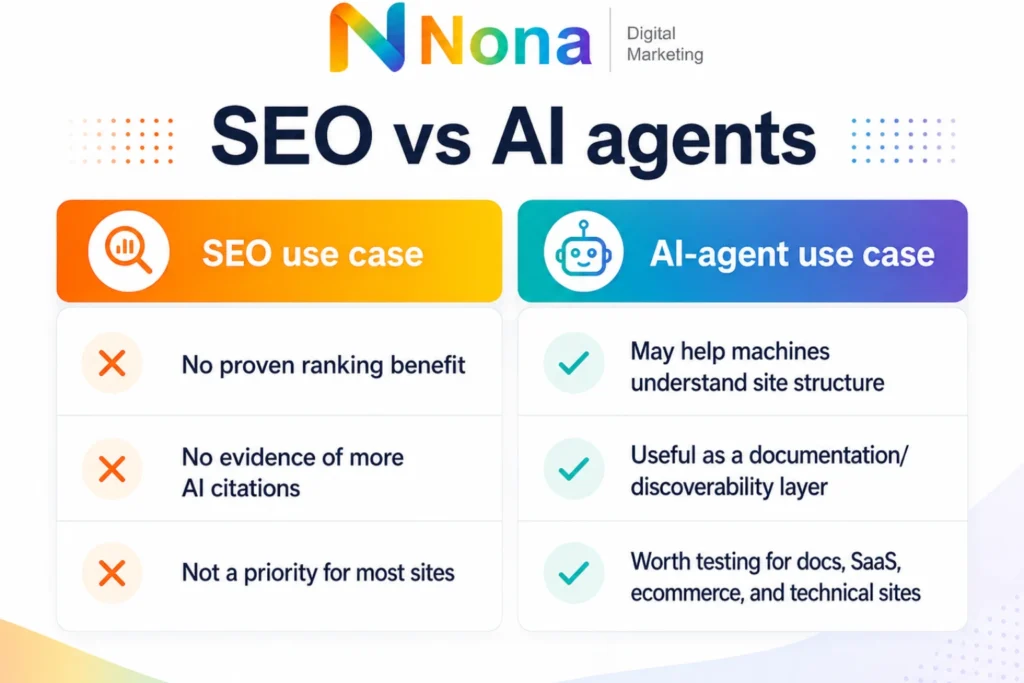
On one side, there is the SEO debate. From that perspective, the evidence is clear: there is currently no proof that llms.txt improves rankings, increases AI citations, or makes a website more visible in Google Search, AI Overviews, ChatGPT, Claude, or any other major AI answer engine. For anyone expecting it to work like a shortcut to “AI SEO,” the file is likely disappointing.
On the other side, llms.txt is being discussed as a possible discoverability layer for AI agents. In this context, the goal is not to manipulate rankings or generate citations. The goal is simply to give machines a cleaner, easier-to-read summary of what a website contains, where the most important resources are, and how an AI system might navigate them.
That is why the signals seem contradictory. Google Search may say the file is unnecessary for SEO, while tools, plugins, documentation sites, and AI-focused developers may still experiment with it for other purposes. These are not necessarily opposing views. They are talking about different use cases.
So the real problem is not the file itself. The problem is the expectation around it.
If you treat llms.txt as an SEO ranking factor, there is no strong reason to believe it will help. But if you treat it as a lightweight, experimental way to organize your content for future AI agents, it starts to make more sense.
In short, llms.txt is confusing because it sits between two worlds: traditional SEO, where it currently has no proven impact, and the emerging world of AI agents, where its role is still being tested.
The fact that llms.txt is showing up in these places does not mean the protocol has been validated or widely adopted. It simply means that some tools and platforms are experimenting with it. And, as we know, not every suggestion from these platforms is automatically useful. Yoast’s writing recommendations are a good example of advice that often needs to be taken with a grain of salt.
Still, this creates noise. Site owners see one Google source suggesting that llms.txt is unnecessary, while another tool or document appears to recommend it. Naturally, that makes people wonder whether Google has changed its mind, whether the advice is inconsistent, or whether they are missing something important.
The simpler explanation is that these recommendations are about different use cases.
For SEO, llms.txt does not currently offer a proven benefit. But for certain types of websites, especially documentation-heavy sites, it may help AI agents understand and navigate content more easily.
That is why the guidance can look contradictory: one part of the conversation is about search visibility, while the other is about machine readability and AI-agent discoverability, agents on certain types of websites. That is why Google’s instructions change depending on the documentation you access.
So, should I create an llms.txt file for my website?
t really comes down to what you are trying to achieve.
- If your goal is to improve SEO performance or appear more often in AI-powered search results, llms.txt is probably not worth prioritizing right now. There is no clear evidence that it helps with rankings, citations, or visibility.
- If your goal is to make your site easier for AI agents to understand and navigate, then it may be worth testing. But even then, it is important to remember that llms.txt is still only a proposed protocol. We do not yet know how widely it will be adopted, which agents will read it, or whether it will become a meaningful standard.
So, in either case, expectations should stay realistic. Do not expect immediate results, and do not treat llms.txt as a high-priority technical task.
So far, its most practical use seems to be helping AI agents understand what is on a site and how to complete certain tasks. That means the value of llms.txt can vary a lot depending on the type of website. For a publisher, the return may be limited. For a software company, documentation platform, SaaS product, or ecommerce site with structured user journeys, the case may be stronger.
My recommendation is to look at your own site before deciding, ask whether llms.txt makes sense based on your current setup, the effort required to create and maintain it, and the potential upside if AI-agent adoption increases.
Also consider the risk of inconsistencies between your website and the Markdown version of your content. If the site changes but the llms.txt file does not, you may end up giving machines outdated or incomplete information.
And if you decide to implement it, treat it as an experiment. Define what you want to learn, how you will monitor results, and what would make the test worth continuing.
For teams that need SEO results now, there are usually more urgent priorities: crawlability, technical SEO, JavaScript rendering, internal linking, content quality, structured data, and overall site performance.
The same logic applies to AI-agent optimization. For most websites, fixing existing technical and content issues will be more valuable than investing too much time in a protocol that is still finding its place.
Want to keep up with what is actually working in SEO? Follow the Nona Digital Marketing blog, where I publish weekly analysis on the latest trends and changes in digital marketing.
Get in touch with us today and let’s turn this update into an opportunity for stronger search performance.
Make sure your website is built for SEO growth.
We’ll review the technical issues that may be hurting crawlability, indexation, speed, rankings, and long-term organic performance.