
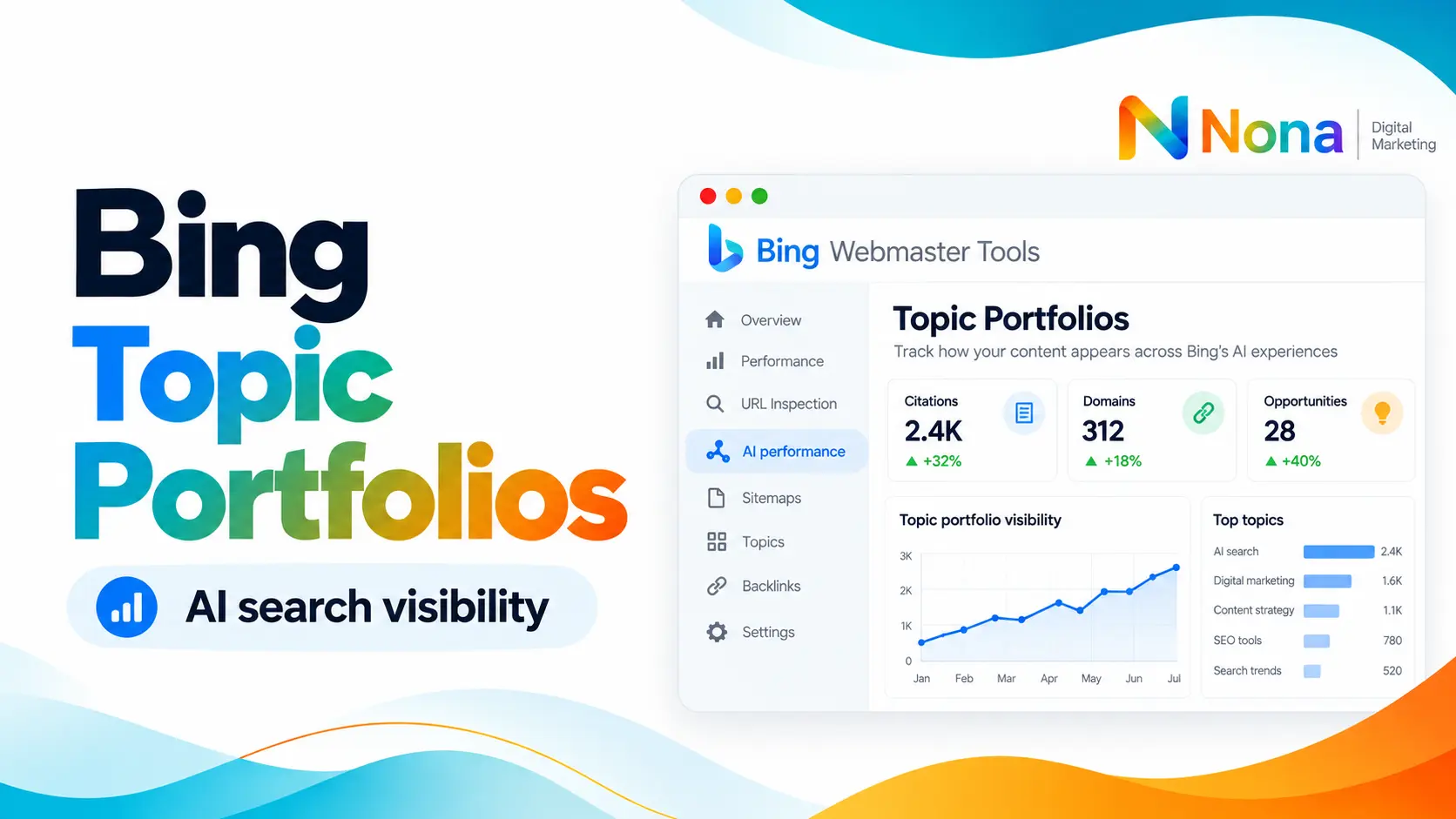
Microsoft is introducing Topic Portfolios in Bing Webmaster Tools, a new feature designed to help website owners, SEO professionals, and marketers better understand how their content performs across AI-powered search experiences, including Bing and Microsoft Copilot.
This is an important development for AI search optimization (AEO) because it introduces a more meaningful way to measure visibility: instead of focusing exclusively on individual keywords or prompts, topic portfolios group related search queries into broader topics.
The result is a more comprehensive view of how websites are discovered, cited, and represented in AI-generated answers, along with valuable insights into competitor performance and content opportunities.
Table of Contents
- What are Topic Portfolios in Bing Webmaster Tools?
- Key features of Bing’s Topic Portfolios
- Why topic-based tracking is better than tracking individual AI prompts
- How Topic Portfolios can improve AI search competitor analysis
- Bing Webmaster Tools vs. Google Search Console: A new direction for AI SEO analytics
- How to get started with Bing Webmaster Tools
- The future of AI search visibility measurement
What are Topic Portfolios in Bing Webmaster Tools?
Topic Portfolios is a new AI search visibility feature that organizes related queries into thematic groups, allowing website owners to analyze their performance across entire subject areas.
Traditional SEO tools have historically relied on keyword-level metrics, such as rankings, impressions, and clicks. While these metrics remain important, they don’t fully capture how visibility works in AI-powered search.
Users interact with AI search engines differently. They ask longer questions, use conversational language, and express similar search intents in many different ways.
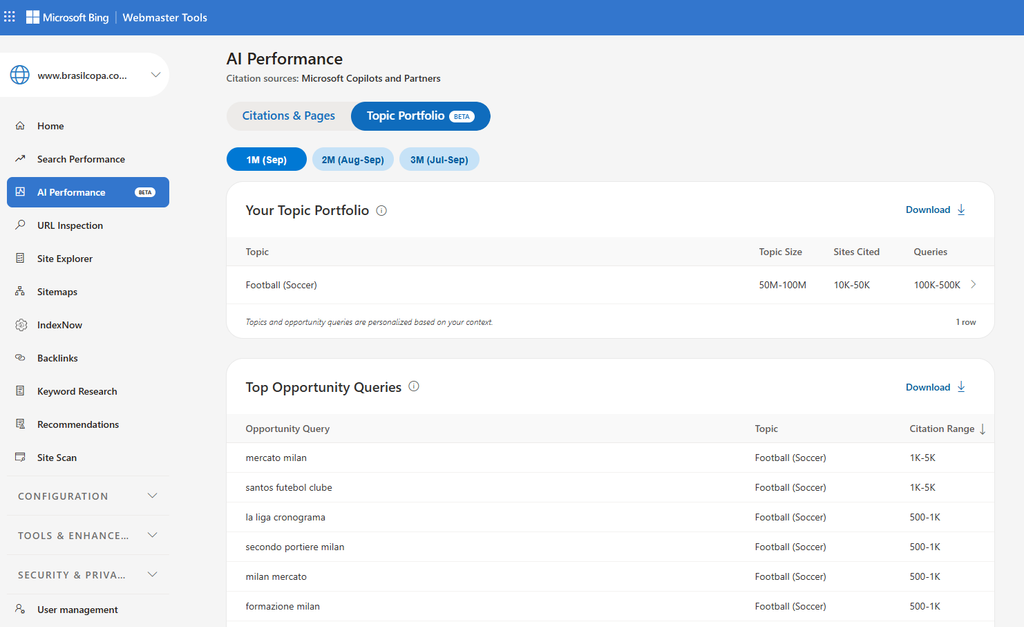
By grouping related queries into topics, Microsoft provides a broader perspective on how websites gain exposure through AI-generated responses.
Rather than tracking whether your website appears for a specific prompt, Topic Portfolios helps answer a more strategic question:
How visible is your website across the topics that matter most to your business?
Key features of Bing’s Topic Portfolios
Topic Portfolios introduces several useful metrics and insights for understanding AI search performance.
1. Topic-level query coverage
The feature provides visibility into the broader universe of related queries contributing to a website’s presence across Microsoft’s AI-powered search experiences.
This makes it easier to understand which subjects are driving AI visibility without analyzing individual prompts separately.
2. Topic size and citation volume
Each topic includes an estimate of its overall size, based on the total volume of citations generated across websites within that topic.
This helps marketers understand the relative importance of different topics and identify areas where AI search activity is concentrated.
3. Competitive visibility analysis
Topic Portfolios also provides an estimate of how many unique domains receive citations within a particular topic.
This adds valuable competitive context, helping website owners understand how their visibility compares with the broader landscape.
Instead of viewing AI citations in isolation, marketers can begin evaluating how competitive individual topics are.
4. Content gap and AI search opportunities
One of the most interesting elements is the opportunities section.
It highlights subtopics where competing websites are receiving AI citations but your website is not.
For SEO and content teams, this could be particularly valuable when prioritizing new content, improving existing pages, or identifying gaps in topical coverage.

Why topic-based tracking is better than tracking individual AI prompts
One of the biggest challenges in measuring AI search visibility is that individual prompts are highly variable.
Two people looking for exactly the same information might phrase their questions completely differently.
For example, someone researching AI SEO could ask:
- How can I optimize my website for AI search?
- What is the best strategy to appear in ChatGPT or Copilot?
- How do brands increase visibility in AI-generated answers?
- What are the most important AI search ranking factors?
Although these prompts are different, they belong to a similar broader topic.
Measuring each prompt individually can create fragmented reporting and make it difficult to understand a brand’s actual presence across the subject.
Topic-level measurement provides a more consistent and strategically useful perspective.
It shifts the focus from tracking isolated questions to evaluating whether a brand is represented across an entire area of expertise.
This is especially relevant as AI search becomes more conversational, personalized, and context-dependent.
How Topic Portfolios can improve AI search competitor analysis
Another major advantage of Topic Portfolios is the ability to understand AI visibility within a competitive landscape.
Knowing that your website received a certain number of citations is useful, but that information becomes significantly more valuable when placed in context.
For example:
- Which competitors are being cited across the same topics?
- Which subject areas have the strongest competitive presence?
- Where are other websites gaining visibility that yours is missing?
- Which subtopics could represent opportunities for new content?
- How can your content strategy be adjusted to improve topical visibility?
These insights can help SEO teams move beyond reporting metrics and start making more informed strategic decisions.
The real value of AI search analytics is not simply knowing how visible your website is, but understanding why, where, and against whom you’re competing.
Topic Portfolios represents an interesting step in that direction.
Bing Webmaster Tools vs. Google Search Console: A new direction for AI SEO analytics
Microsoft has been making notable progress with Bing Webmaster Tools, particularly in the area of AI search performance reporting.
Microsoft has already introduced several useful AI Performance features, including Intents, Topics, Citation Share, and Compare. We covered these updates in detail in our previous article on Bing Webmaster Tools AI visibility features, which explains how these metrics can help SEO professionals better understand their presence in AI-generated answers.
While Google Search Console remains essential for monitoring traditional organic search performance, Bing Webmaster Tools is becoming increasingly valuable for understanding how websites appear in AI-powered experiences.
Features such as Topic Portfolios reflect a growing need for analytics that go beyond traditional keyword rankings and organic clicks.
As AI-generated answers become a more prominent part of search, marketers need better ways to understand citations, topical presence, and competitive visibility.
In this context, Microsoft’s approach is particularly interesting because it connects AI visibility metrics with practical content opportunities.
For businesses investing in Generative Engine Optimization (GEO) and Answer Engine Optimization (AEO), these insights could become an important part of their search performance analysis.
How to get started with Bing Webmaster Tools
Topic Portfolios is currently in beta, which means the feature may not yet be available to every website owner.
However, Bing Webmaster Tools already offers useful capabilities for monitoring website performance and understanding visibility within Microsoft’s search ecosystem.
If your website isn’t connected to Bing Webmaster Tools yet, it’s worth setting it up now.
Doing so allows you to start exploring the available data and be better prepared as Microsoft expands its AI search analytics capabilities.
You can get started through Bing Webmaster Tools.
The future of AI search visibility measurement
AI search optimization requires a different approach to measuring success.
Traditional SEO metrics will continue to matter, but they don’t tell the entire story of how brands are discovered and represented in AI-generated answers.
Tracking thousands of individual prompts is unlikely to provide a complete picture either.
The future of AI search measurement is likely to be more topic-driven, contextual, and competitive.
Bing’s Topic Portfolios is an encouraging development because it brings these elements together, helping marketers better understand their visibility across broader subjects rather than isolated queries.
More importantly, it can help turn AI search data into actionable insights for content planning, competitive analysis, and organic growth.
As AI-powered search continues to evolve, businesses need to understand not only how they perform in traditional search engines, but also how their brands appear in AI-generated answers.
At Nona Digital Marketing, we help businesses navigate the changing search landscape, identify opportunities, and develop SEO and AI search optimization strategies designed to improve organic visibility.
Whether you’re looking to understand your current AI search performance, uncover competitive gaps, or build a stronger content strategy, our team can help.
Want to improve your brand’s visibility across Google, Bing, Copilot, and other AI-powered search experiences?
Improve your visibility across AI-generated answers, Bing AI Performance reports, and search engines with content strategies built for the next generation of SEO.