
Artificial intelligence is changing the way content is created, published, and consumed online. As tools such as Claude become increasingly capable of producing human-like text, a growing challenge has emerged: how can we determine whether a piece of content was written by a human or generated by AI? This is where the Claude AI Watermark becomes increasingly relevant, offering a potential way to identify AI-generated content and improve transparency online.
Anthropic is exploring a solution through an invisible watermark for AI-generated text. The technology is designed to help identify content created by Claude, potentially giving platforms, publishers, educators, and search engines a new way to understand where online content comes from.
Table of Contents
What is the Claude AI watermark?
The Claude watermark is designed to be invisible to ordinary readers. Instead of adding a visible label or changing the appearance of a document, the technology embeds information into the text during the generation process.
Specialized detection systems can potentially analyze this information and determine whether the content was generated by a compatible Claude model.
This approach is particularly interesting because the watermark is intended to remain associated with the generated content even when the text is copied and pasted into another document, website, or platform.
In other words, the technology is not necessarily tied to the original location where the content was created.
How does Claude’s invisible watermark work?
Rather than functioning like a traditional image watermark, an AI text watermark can be incorporated into the way a language model generates text.
To a human reader, the resulting article may look completely normal. There is no obvious symbol, warning, or notification indicating that artificial intelligence was involved.
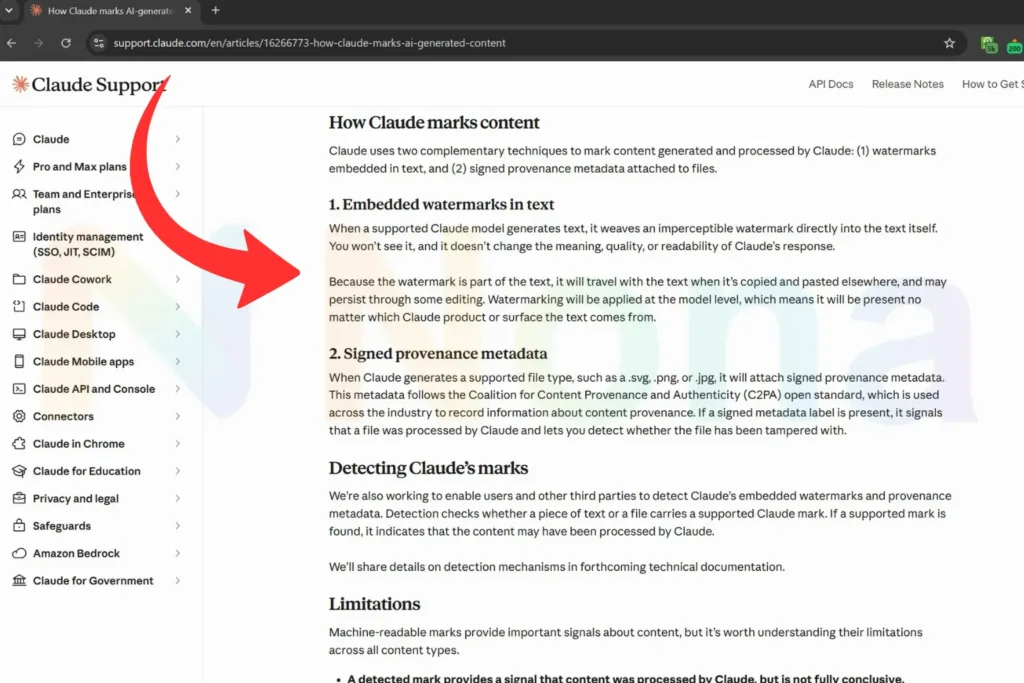
The identification process happens behind the scenes through specialized detection technology.
This distinction is important because AI-generated content can be easily copied and redistributed. If detection depended only on the original platform, identifying the source would become much more difficult once the text moved elsewhere.
Why AI-generated content detection matters
The rapid growth of generative AI has created an enormous amount of automatically produced content.
People can now use AI to write blog posts, product descriptions, social media posts, emails, reports, and even academic assignments within seconds. As a result, distinguishing between human-written and AI-generated content is becoming increasingly difficult.
A reliable identification system could provide additional transparency for organizations that need to understand the origin of digital content.
For publishers and websites, this could help establish clearer editorial policies. For educators, it could provide another tool for understanding how assignments were produced. And for online platforms, AI identification could become part of broader content-quality and authenticity systems.

Claude watermarking and the future of SEO
The development of AI watermarks could also have important implications for SEO and search engines.
As the volume of AI-generated content continues to increase, search engines may need better ways to evaluate the origin, quality, originality, and usefulness of online information.
However, identifying AI-generated text does not automatically mean that the content is low quality.
AI-assisted content can be useful, accurate, and well researched. Likewise, human-written content can contain errors or misinformation. Therefore, an AI watermark should not necessarily be treated as a direct measure of content quality.
Instead, it could become another signal that helps search engines and platforms better understand the content they process.
Will other AI models use watermarks?
Claude is not the only AI system moving toward greater content transparency.
Other technology companies are also developing methods to identify or label AI-generated material. Google, for example, has introduced initiatives focused on identifying AI-generated content across different media formats.
This suggests that AI content detection and watermarking could become increasingly common as generative AI becomes a standard part of digital content creation.
What does the Claude watermark mean for content creators?
For content creators, the development represents an important shift.
Using AI to assist with writing may become increasingly transparent, even when the final text appears entirely natural. Rather than focusing exclusively on whether AI was used, however, the more important question may be how the technology was used.
AI can be a powerful writing assistant, but originality, fact-checking, expertise, and editorial judgment remain essential.
Ultimately, Claude’s AI watermark is part of a much larger conversation about trust, transparency, and authenticity in the age of generative AI.
As artificial intelligence becomes better at creating content that looks human, technologies capable of identifying its origins may become just as important as the AI models themselves.
As AI continues to transform how businesses create content and reach their audiences, having the right strategy is more important than ever. From AI-powered content strategies and automation to technical SEO and search visibility, businesses need to adapt to a rapidly changing digital landscape.
If you want to use AI strategically while building a strong, sustainable SEO presence, Nona Digital Marketing can help.
Whether you need support with AI solutions, SEO strategy, content optimization, or digital marketing, our team can develop a tailored approach based on your business goals.
Need help improving your visibility in AI search?
Improve your visibility across AI-generated answers, Bing AI Performance reports, and search engines with content strategies built for the next generation of SEO.