
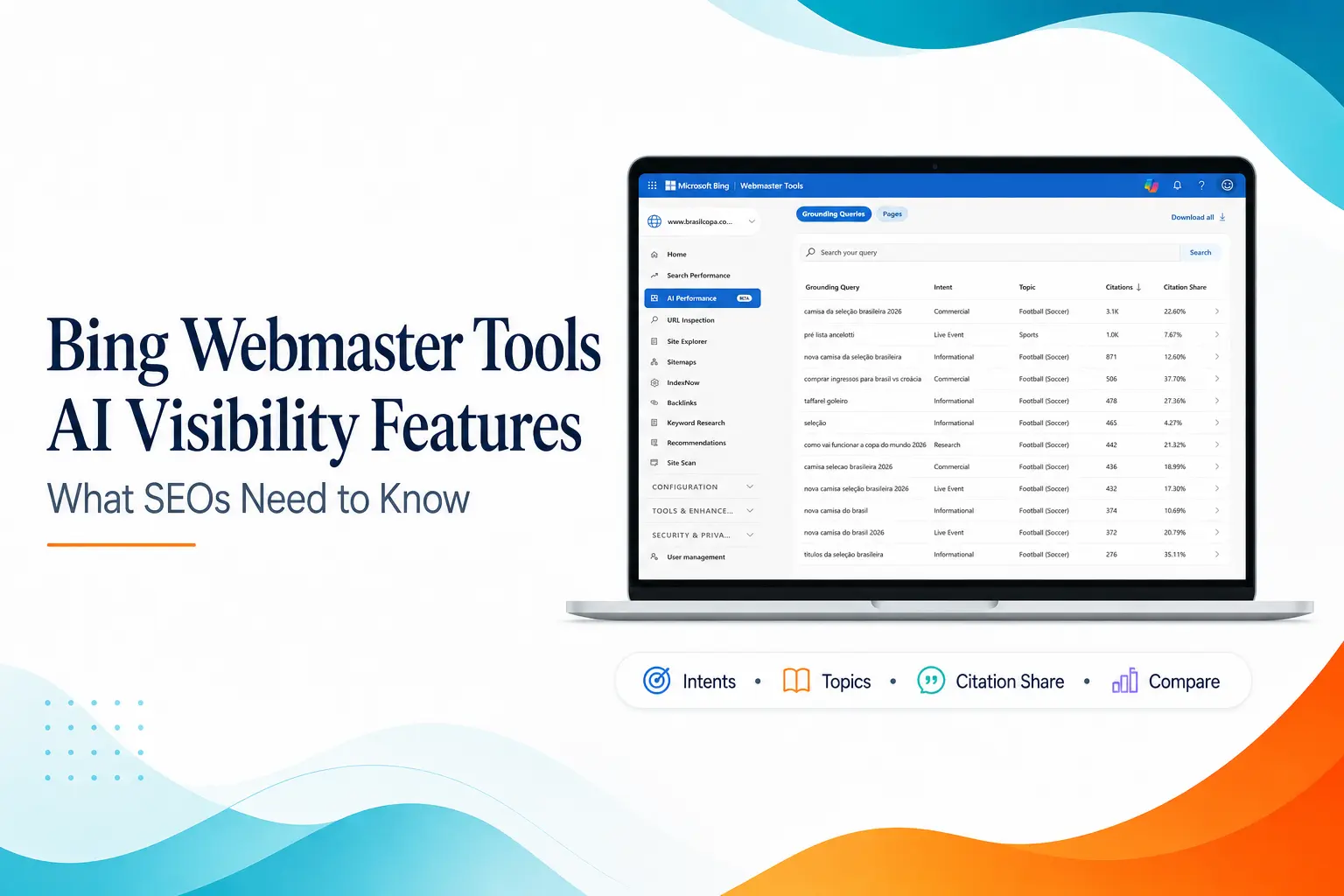
Bing Webmaster Tools AI visibility is becoming an important topic for SEO professionals, digital marketers, publishers, and business owners who want to understand how their content appears in AI-generated answers.
For many years, SEO reporting was mostly about rankings, impressions, clicks, backlinks, and keyword positions. Those metrics are still important, but they no longer tell the full story. Search is changing, and AI-powered answers are now becoming part of the discovery journey.
When someone uses Microsoft Copilot, Bing AI-generated summaries, or selected AI partner experiences, the answer may include citations from different websites. This means your content can influence a user’s decision even when the experience does not look like a traditional search results page.
That is why the new AI visibility features inside Bing Webmaster Tools are so important.
Microsoft recently expanded the AI Performance experience in Bing Webmaster Tools with new reporting features such as Intents, Topics, Citation Share, and Compare. These updates help website owners better understand how their content is being cited, what type of user intent is connected to those citations, which topics are driving visibility, and how AI search visibility changes over time.
For marketers, this is a major step toward making AI search optimization more measurable.
Table of Contents
- Why Bing Webmaster Tools AI visibility update matters
- What are the new AI performance features in Bing Webmaster Tools?
- Intents: Understanding why your content appears in AI answers
- Topics: How Bing groups queries beyond traditional keywords
- Citation Share: A new AI search visibility metric
- Compare: Tracking AI visibility changes over time
- How these Bing Webmaster Tools updates affect SEO strategy
- Example of AI Performance data in Bing Webmaster Tools
- My opinion on Bing’s new AI visibility features
Why Bing Webmaster Tools AI visibility update matters
AI search has changed the way users interact with information.
In traditional search, a user types a query, reviews a list of links, clicks a result, and visits a website. In AI-powered search, the experience can be different. The user may receive a summarized answer, supported by citations from websites that the AI system used as sources.
This changes how we think about visibility.
A website might not always receive a click immediately, but it can still be cited as a trusted source in an AI-generated answer. That citation may influence brand perception, build authority, and help users discover a company, product, or service later.
This is especially important for businesses that rely on informational content, product guides, comparison pages, educational articles, news, affiliate content, or local service pages.
The big question is no longer only:
“Are we ranking on Google or Bing?”
Now, marketers also need to ask:
“Are AI systems using and citing our content?”
The new Bing Webmaster Tools AI Visibility features help answer that question.
What are the new AI performance features in Bing Webmaster Tools?
The AI Performance report in Bing Webmaster Tools was created to show how publisher content appears across Microsoft Copilot, AI-generated summaries in Bing, and selected partner integrations. Microsoft describes this as an early step toward Generative Engine Optimization reporting, giving publishers more visibility into how often their content is cited in AI answers.
The latest updates add more useful context to that data.
Instead of only seeing that your website was cited, you can now understand more about the query, the user intent, the broader topic, and your share of citations for that query.
The main new features are the following:
- Intents:classifies grounding queries by the user’s likely goal.
- Topics: groups related queries into broader subject areas.
- Citation Share: shows your website’s share of citations for a specific grounding query.
- Compare: allows you to compare AI visibility performance across different time periods.
Together, these features make the report much more actionable for SEO and content strategy.
Intents: Understanding why your content appears in AI answers
Intent is one of the most valuable parts of modern SEO.
A keyword alone does not always explain what the user actually wants. For example, a query like “new Brazil jersey 2026” may have commercial intent if the user wants to buy the shirt. But a query like “history of Brazil national team shirts” may be informational.
Bing’s Intents feature helps classify grounding queries into broader user-intent categories. According to Microsoft, these can include categories such as Informational, Commercial, Navigational, Research, Learn and Solve, Creation, Local, and others.
This matters because AI systems are not only matching keywords. They are trying to understand meaning, context, and the reason behind the search.
For content teams, this creates better strategic insight.
If your site is being cited mainly for informational queries, your educational content may be performing well. If your site is appearing for commercial queries, your product pages, buying guides, reviews, or comparison content may be gaining authority.
This helps marketers stop thinking only in terms of keywords and start thinking in terms of user journeys.
A strong SEO strategy should include content for multiple intents, including awareness, consideration, comparison, and conversion. The new Intents feature gives website owners a clearer view of where their content is already working and where there may be gaps.
Topics: How Bing groups queries beyond traditional keywords
The Topics feature is another important update because it reflects how AI search understands content.
Traditional keyword research often focuses on individual search terms. But AI systems connect related concepts. They do not only look at one query in isolation. They evaluate broader subject areas and how well a website covers a topic.
Microsoft explains that Topics group related grounding queries into broader thematic clusters. For example, several queries related to solar panels, residential solar installation, and energy efficiency could be grouped under a broader topic such as solar energy.
This is very relevant for SEO because it reinforces the importance of topical authority.
A website that publishes one isolated article about a topic may have limited visibility. But a website that covers the topic deeply, with helpful supporting articles, FAQs, internal links, structured information, and updated content, has a better chance of being understood as a reliable source.
For agencies and website owners, Topics can help answer questions like:
Which subject areas are already generating AI citations?
Which themes deserve more content investment?
Are we building enough depth around our most valuable services?
Are AI systems connecting our website with the topics we want to be known for?
This makes content planning more strategic and less dependent on isolated keyword ideas.
Citation Share: A new AI search visibility metric
Citation Share may be one of the most useful new metrics in Bing Webmaster Tools.
According to Microsoft, Citation Share shows the percentage of citations attributed to your site out of all citations shown across sites for the same grounding query. Microsoft also explains that this is an observational metric. It is not a ranking score, quality score, or traffic share report.
That distinction is important.
Citation Share does not mean your website is “ranking number one” in AI search. Instead, it gives you a directional view of how often your site is being used as a citation compared with other sources for the same query.
This can be extremely useful for AI content optimization.
For example, if your site has a low Citation Share for an important query, you may need to improve the page’s clarity, structure, freshness, topical depth, or supporting content. If Citation Share increases after a content update, that can be a positive signal that your optimization work is helping AI systems better understand and trust your content.
In practical terms, Citation Share starts to feel like an AI search version of share of voice. It does not replace rankings or clicks, but it gives marketers another way to evaluate visibility.
Compare: Tracking AI visibility changes over time
AI visibility is not static.
Your content may be cited more often during a seasonal trend, after a content update, when a topic becomes popular, or when Bing’s AI systems refresh their understanding of a subject. It may also decline if competitors publish better content or if your pages become outdated.
The Compare feature helps website owners monitor these changes.
With Compare, marketers can review AI visibility performance across different time periods. For example, you can compare the last 30 days with the previous 30 days and look for changes in citations, topics, intents, and Citation Share.
This is especially useful after SEO work.
If your agency updates an article, improves structured data, strengthens internal linking, adds expert commentary, or expands a topic cluster, Compare can help you see whether citation patterns changed afterward.
It will not prove causation by itself, but it gives you valuable clues.
For SEO reporting, this is a big improvement because it helps connect content optimization work with AI visibility trends.
How these Bing Webmaster Tools updates affect SEO strategy
These updates do not mean traditional SEO is dead.
Actually, they show that SEO fundamentals are more important than ever.
AI search systems still need to crawl, understand, evaluate, and cite content. That means technical SEO, indexability, structured data, clean site architecture, content quality, topical authority, and trust signals all continue to matter.
The difference is that content now needs to be optimized for both traditional search results and AI-generated answers. That is why understanding how to create AI content the right way is becoming essential for brands that want to stay visible in search.
That means your pages should be easy to understand, well organized, accurate, and helpful. They should answer the user’s question clearly, support claims with reliable information, and make the main topic obvious.
For businesses, this creates a new opportunity.
Instead of producing generic blog posts, brands should focus on content that demonstrates expertise and solves real user problems. AI systems are more likely to cite pages that are clear, complete, trustworthy, and relevant to the query.
In my view, AI search optimization is not about tricking algorithms. It is about making your content easier to trust, easier to extract, and easier to cite.
Example of AI Performance data in Bing Webmaster Tools
Below is a real example from one of our own websites inside Bing Webmaster Tools. The AI Performance report shows how Bing organizes grounding queries by intent, topic, total citations, and Citation Share.
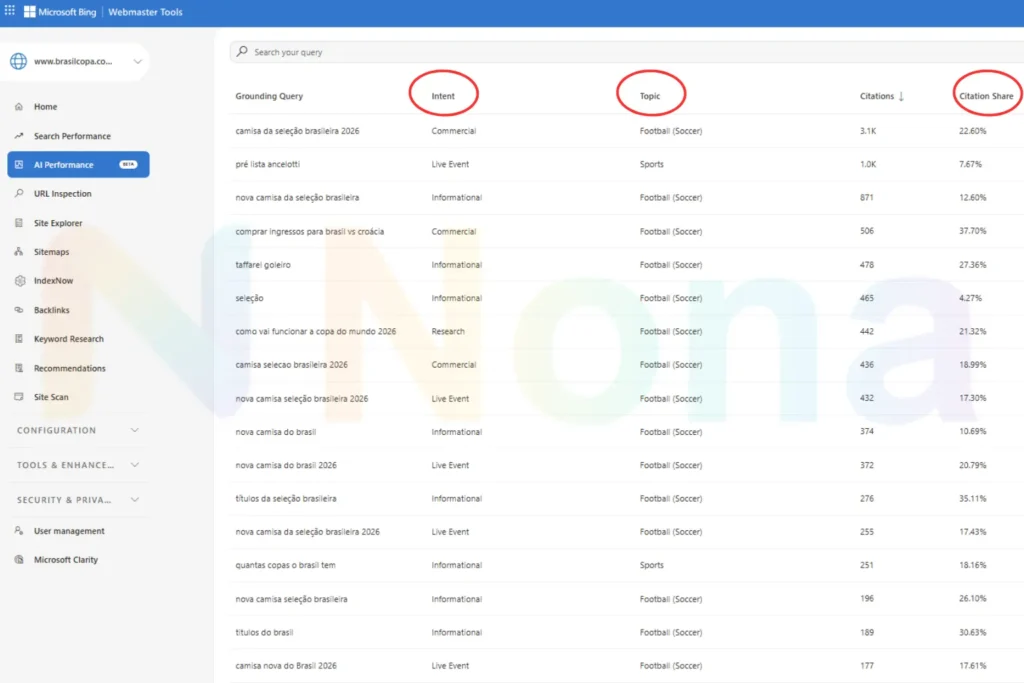
Example of Bing Webmaster Tools’ AI Performance report showing grounding queries, intent, topic, citations, and Citation Share for one of our websites.
This example is useful because it shows how the report works in a real situation. Instead of only seeing that the website was cited, we can understand which queries generated visibility, what intent Bing assigned to those queries, which topic they belong to, how many citations were recorded, and what percentage of citation share the website received.
For an agency, this type of data is valuable because it helps guide content strategy.
If a topic is already generating AI citations, we may want to strengthen that topic with better supporting pages, updated content, internal links, FAQs, and structured data. If a commercial query has strong citation potential, we may want to improve the related landing page or product content.
This turns AI visibility into something we can analyze, track, and improve over time.
My opinion on Bing’s new AI visibility features
In my opinion, this is one of the most important updates Bing Webmaster Tools has released in recent years.
Google still dominates traditional search volume, but Bing is doing something very valuable by giving website owners more transparency into AI-generated answers. For the first time, many marketers can start seeing how their content is being cited inside AI search experiences instead of guessing.
Of course, this data should not be treated as the complete picture of AI visibility. It mainly reflects supported Microsoft experiences, including Microsoft Copilot, Bing AI-generated summaries, and selected partner integrations. It does not represent every AI platform or every search behavior.
But it is still a major step forward.
For SEO consulting professionals, this gives us a new layer of reporting. For business owners, it gives a better understanding of how content can create visibility even when the user journey does not begin with a traditional click.
The brands that start paying attention to AI visibility now will have an advantage later. They will understand which topics they are trusted for, which intents they are appearing in, and where their content needs to improve.
AI search is not the future anymore. It is already part of search.
AI content optimization is not just about publishing more articles. It is about improving clarity, structure, topical authority, trust signals, and the way your content answers real user questions.
If you need help with AI content optimization, Nona Digital Marketing can help you analyze your Bing Webmaster Tools AI Visibility, improve your content structure, and prepare your website for the next stage of search.
Need help improving your visibility in AI search?
Improve your visibility across AI-generated answers, Bing AI Performance reports, and search engines with content strategies built for the next generation of SEO.