
Google may soon allow businesses to connect their Google Business Profile with Google Analytics. According to Search Engine Roundtable, the Google Business Profile and Google Analytics Integration may be rolling out soon. The report says Google emailed some businesses about the feature, noting that it would become available over the next few weeks, although it was not showing in every account at the time of publication.
I also looked for a broader official announcement from Google, but I could not find a dedicated post on Google’s official blog at the time of writing. That makes this a developing update worth watching closely, especially because Search Engine Roundtable also points to Google support and community references related to the feature.
If this becomes available widely, it could be a meaningful update for local businesses, SEO professionals, marketing agencies, and brands that manage several locations.
At first, this might sound like just another small Google product update. But for anyone who works with local SEO or tracks leads from Google Maps, it could solve a problem that has existed for years: local customer actions are often split across different platforms.
Google Business Profile shows how people interact with a business on Google Search and Google Maps. Google Analytics shows what people do on a website or app. Both are useful, but they do not always tell the full story when viewed separately; that gap matters.
A potential customer might find a business on Google Maps, read reviews, check the hours, tap to call, ask for directions, and visit the store without ever clicking through to the website. From a traditional website analytics point of view, that customer may barely exist. But from a business point of view, that person could be one of the most valuable leads of the day.
That is why a direct connection between Google Business Profile and Google Analytics could be so helpful. It would give businesses a better way to understand how their local presence on Google contributes to real actions, not just website visits.
Table of Contents
What the rumored Google Business Profile and Google Analytics integration means
The idea behind the integration is fairly simple: businesses would be able to connect their Google Business Profile data to Google Analytics. Instead of checking profile interactions in one place and website behavior in another, some of those local performance metrics could become available inside Analytics.
Based on what has been discussed so far, the integration could include actions such as website clicks, calls, direction requests, messages, bookings, menu interactions, and other forms of engagement from the business profile.
For local businesses, these are not vanity metrics. They are often the actions that matter most.
A phone call can turn into an appointment. A direction request can turn into a store visit. A menu click can turn into a table reservation. A website click from the business profile can turn into a lead form submission, purchase, or quote request.
The value of the integration is not just that it adds more numbers to Google Analytics. The real value is that it could bring more context to the way businesses understand customer behavior.
The way people search is changing. Users may discover a business through Google Maps, traditional search results, AI-powered answers, or other search experiences. That makes it even more important to understand how SEO is evolving with AI search.
Why local business data has been hard to measure
Local marketing has always been a little messy to measure. A customer’s journey does not always begin and end on a website.
Someone searching for a nearby service might compare three businesses directly in Google Maps. They may look at reviews, photos, business hours, and service descriptions before deciding who to contact. In many cases, the website is only one small part of that decision — and sometimes it is not part of the decision at all.
That creates a reporting problem.
If a business only looks at Google Analytics, it may underestimate how much value is coming from Google Search and Maps. If it only looks at Google Business Profile insights, it may miss what happens after someone clicks through to the website.
This is especially important for industries like healthcare, restaurants, law firms, home services, real estate, retail, beauty, fitness, and professional services. In these markets, customers often take action quickly. They want a phone number, an address, an appointment link, a menu, or directions. They are not always browsing for long periods.
A direct integration could help close that measurement gap.
A more natural view of the customer journey
One of the biggest benefits of connecting Google Business Profile with Google Analytics would be a more realistic view of the customer journey.
Right now, it is easy to treat website traffic as the center of everything. But for local businesses, the business profile itself often acts like a mini landing page inside Google. It has photos, reviews, contact buttons, service information, booking links, directions, and sometimes even products or menus.
In other words, a lot of decision-making happens before the user ever reaches the website.
If Google Business Profile data appears inside Google Analytics, businesses may be able to understand that journey more clearly. They could see how local discovery connects with website visits, calls, bookings, direction requests, and other meaningful actions.
That kind of visibility can change the way businesses think about local SEO. Instead of asking only, “How much traffic did we get?”, they can start asking better questions, such as:
- How many people found us and decided to call?
- How many people requested directions after seeing our profile?
- Are users clicking through to the website after interacting with our business profile?
- Did a local campaign increase actions on the profile, not just traffic to the site?
Those are better questions because they are closer to business outcomes.
Main benefits for local businesses and SEO reporting
If the integration becomes widely available, the biggest winners will likely be businesses that rely on local visibility to generate calls, appointments, visits, bookings, and leads.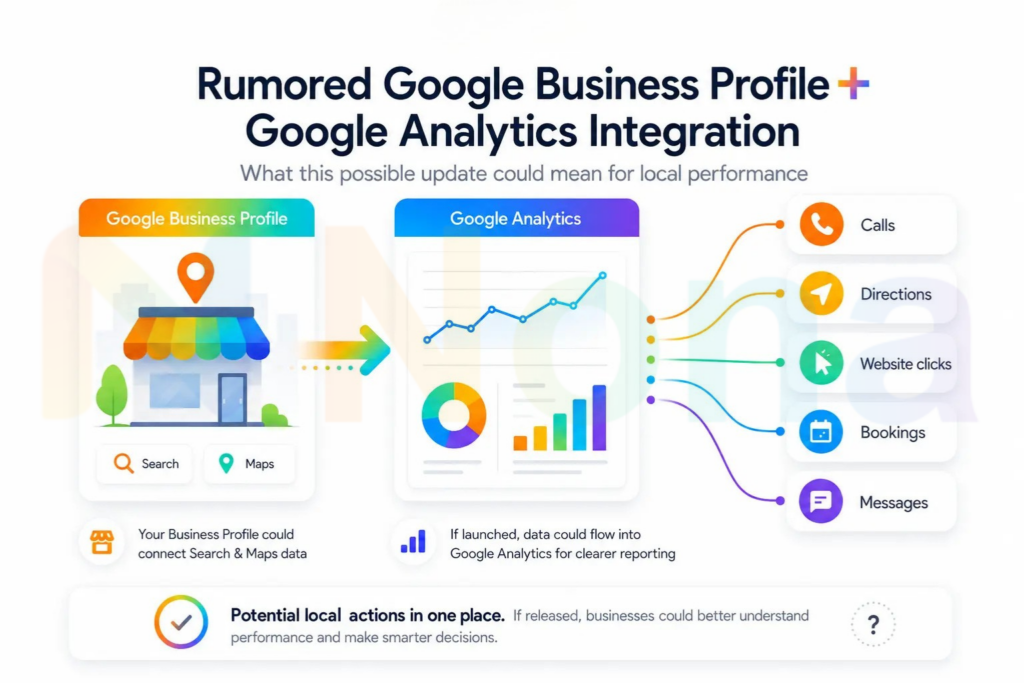
It may also be useful for agencies and marketing teams that need to show the impact of local SEO more clearly. Local SEO work is often valuable, but it can be hard to explain when the results are scattered across multiple dashboards.
Fewer Disconnected Reports
One of the most practical benefits is simple: fewer tabs, fewer disconnected reports, and a clearer view of what is actually happening.
Today, a marketer may need to check Google Business Profile for calls and direction requests, Google Analytics for website sessions and conversions, Google Ads for paid campaign data, and maybe Looker Studio or another reporting tool to tie everything together.
That workflow is manageable, but it is not ideal. It also makes it easier for important insights to get lost.
With a Google Business Profile and Google Analytics connection, businesses could have more of their local performance data in one place. That would make reporting easier and help business owners understand the relationship between local visibility and customer action.
For agencies, this could also make client reporting more persuasive. Instead of only showing rankings, traffic, or impressions, agencies could point to actions that feel much closer to revenue: calls, directions, bookings, messages, and website clicks.
Better Measurement of High-Intent Actions
Not every interaction has the same value.
A profile view is useful, but a phone call usually means more. An impression is good, but a request for directions often shows stronger intent. A website click matters, but a booking or message may be even more important.
That is why this potential integration is so interesting. It could make it easier to track high-intent actions from Google Business Profile inside the same environment where businesses already analyze website behavior.
For a restaurant, that might mean seeing how menu views, calls, and direction requests change after new photos are added.
For a dental office, it might mean understanding whether service updates or review growth lead to more calls and appointment clicks.
For a retail store, it could show whether local search visibility is turning into direction requests and in-store visits.
For a law firm, it could help connect local discovery with website inquiries, calls, and consultation requests.
These details matter because they show whether local visibility is producing real demand. A business does not just want to appear on Google. It wants people to take action.
Stronger Local SEO Decisions
Local SEO is not only about rankings. Rankings are important, of course, but they are only part of the picture.
A business can rank well and still fail to convert users if its profile is incomplete, its reviews are weak, its photos are outdated, or its services are unclear. On the other hand, a well-optimized profile can turn search visibility into calls, visits, and bookings.
Having Google Business Profile data inside Google Analytics could help businesses make smarter local SEO decisions. They could look at changes over time and ask what may have influenced performance.
- Did calls increase after updating service descriptions?
- Did direction requests go up after adding better photos?
- Did website clicks improve after changing the primary category?
- Did bookings increase after earning more positive reviews?
These questions are not always easy to answer perfectly, but having more data in one place makes the analysis easier.
It also helps shift the conversation away from “Are we ranking?” and toward “Are people taking action after finding us?” That is a much healthier way to evaluate local SEO.
For local businesses, this update could make it easier to understand how visibility on Google Search and Google Maps turns into calls, direction requests, bookings, and website visits. This is especially important for companies that already understand why local SEO matters for Orlando businesses.
More Useful Campaign Analysis
This integration could also help businesses understand local campaign performance more clearly.
For example, a business might run a seasonal promotion, launch a new service, update its Google Business Profile posts, or increase local ad spend. If the only thing being tracked is website traffic, the campaign might look weaker than it really is.
Why? Because some customers may respond by calling, requesting directions, or booking directly through the profile instead of visiting the website.
By bringing profile actions into Google Analytics, businesses could get a more complete view of campaign impact. They could see whether marketing efforts are creating activity across the full local journey, not just on the website.
This is especially useful for businesses where offline behavior matters. A gym wants visits and memberships. A clinic wants appointments. A restaurant wants calls, reservations, and foot traffic. A home service company wants calls and quote requests.
Website visits are important, but they are not the whole story.
Helpful for multi-location brands
The possible integration could also be valuable for businesses with multiple locations.
Franchises, restaurant groups, healthcare groups, retailers, gyms, law firms, and service brands often manage many Google Business Profiles. Reporting across all of those profiles can become complicated quickly.
If multiple profiles can be connected to Google Analytics, brands may have an easier way to understand overall local performance. They could track broader trends, compare campaign periods, and see whether local engagement is moving in the right direction.
There may still be limitations, especially if the data is aggregated rather than broken down clearly by each location. But even an aggregated view can be useful for leadership teams that want to understand whether Google Search and Maps are driving meaningful engagement across the brand.
For multi-location businesses, this could become another important piece of the local marketing reporting stack.
How businesses should prepare for the integration
Even though the feature may not be available to everyone yet, businesses can still prepare now. In fact, the businesses that prepare early will likely get more value from the integration once it becomes widely accessible.
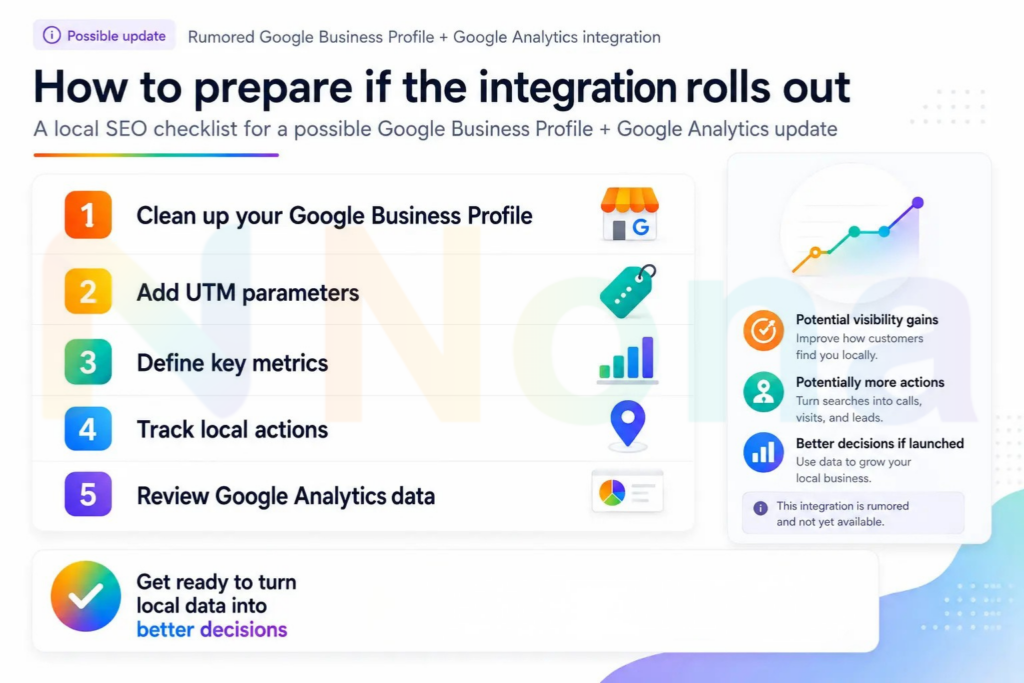
Clean up your Google Business Profile first
Before connecting anything to Analytics, businesses should make sure their Google Business Profile is accurate, complete, and useful.
That means checking the basics: business name, address, phone number, website, categories, hours, services, products, photos, appointment links, menu links, and business description.
It also means looking at the profile from a customer’s perspective. Are the photos current? Are the services clear? Are the hours correct? Are there enough recent reviews? Is the phone number working? Is the website link going to the right page?
A messy profile leads to messy results. If the profile is outdated, the data may show poor performance, but the real problem may be the profile itself.
The cleaner and more helpful the profile is, the more meaningful the Analytics data will be.
Keep using UTM parameters
Even if Google offers a direct connection, UTM parameters will still be useful.
UTMs help businesses identify traffic that comes from specific links. For example, a company can tag the website link in its Google Business Profile so that visits from the profile are easier to separate from other Google traffic.
This is especially helpful when the profile includes multiple links, such as a main website link, appointment link, product link, menu link, or post link.
A direct integration may show profile actions, but UTMs can still provide extra clarity about what users do after clicking through to the website.
Decide which actions actually matter
Before adding more data to reports, businesses should decide what they actually care about.
For some businesses, phone calls are the most important action. For others, it might be direction requests, bookings, appointment clicks, messages, menu views, or website visits.
A restaurant may care most about menu views, calls, reservations, and directions.
A medical clinic may care about calls, bookings, and website clicks.
A retail store may care about directions and product-related traffic.
A law firm may care about calls and consultation requests.
The right metrics depend on the business model. Without that clarity, reports can become crowded and confusing.
The goal is not to track everything just because it is available. The goal is to focus on the actions that are most likely to lead to revenue.
Be aware of possible limitations
It is also important to be realistic. Even if the integration becomes available, it may not be perfect.
Some data may be aggregated. Some reports may not allow the same level of customization as standard Google Analytics reports. Historical data may be limited. Businesses with multiple locations may not get every breakdown they want.
That does not mean the integration is not valuable. It simply means businesses should treat it as one important source of insight, not the only source.
For a fuller picture, companies may still need call tracking, CRM data, Google Ads data, Looker Studio dashboards, booking data, and in-store sales information.
Use the Data to make better decisions
The real value of this integration will not come from looking at another dashboard. It will come from making better decisions.
If direction requests are growing, a business might adjust staffing or store operations.
If calls are dropping, it may need to check its phone setup, business hours, reviews, or service descriptions.
If website clicks are strong but conversions are weak, the landing page may need work.
If bookings increase after profile updates, the business may want to repeat that type of optimization.
If menu views are high but reservations are low, a restaurant may need to review pricing, photos, offers, or the reservation flow.
This is where analytics becomes useful. Not when it simply reports what happened, but when it helps explain what to do next.
What this could mean for the future of local SEO
The rumored connection between Google Business Profile and Google Analytics could be a major improvement for local businesses and marketers.
For years, businesses have had to piece together local performance from separate platforms. Google Business Profile showed profile actions. Google Analytics showed website behavior. But the customer journey often moved between both worlds, and sometimes stayed entirely inside Google Search or Maps.
If Google makes this integration widely available, businesses could finally get a clearer view of how their local presence contributes to calls, directions, bookings, messages, website visits, and other valuable actions.
That would be especially helpful for local SEO, campaign reporting, multi-location management, and business decision-making.
Of course, the integration will not solve every reporting challenge. Businesses should still use UTM parameters, maintain clean profiles, define their most important metrics, and combine analytics data with other sources when needed.
But overall, this rumored update points in a useful direction. It recognizes something local marketers have known for a long time: the customer journey does not always start on a website anymore. As AI mode search behavior changes how users discover, compare, and evaluate businesses, it does not always end on a website either.
For many local businesses, the Google Business Profile is one of the most important digital touchpoints they have. Connecting it with Google Analytics could make that touchpoint much easier to measure, understand, and improve.
Need help turning Google Business Profile insights into real SEO growth?
Improve your local visibility with SEO strategies built for Google Search, Google Maps, and the next generation of AI-assisted search.